This weeks’ energy reflection is on your own Beliefs. Its about what you believe about you, your life and the choices you make based on these believes is exactly what is going to occur in your life. You know as a psychic intuitive life coach magick reader I get people saying to me all the time that psychics will resolve my problems, just like the belief that gods and goddess are here to solve my issues that you created? And my higher mind would ask how is that working for you? What you create is still your issue to resolve not someone else’s issue. How is that thinking even possible? that does even make sense? So you are literally saying that you can do anything you want and someone else(gods and Goddess, psychics, life coaches, friends, parents, spouses, boyfriends, girlfriends someone anyone other than you) need to clean up your mess that you created? really? Learn about your believes. Look at them. There is nothing to feel bad about and no you are not a bad person. If you want your finances to get better look at what you believe about finances, if you want love relationship look at what you believe about love and relationships. You have the power to change it and to choose believes that belong to your own inner truth and walk your truth not someone else’s truth. By not walking your own truth you are walking and living someone else’s lies. And knowingly or unknowingly creating a life based on someone else’s lies, believes and perception. Its time to really look at who you truly are.
This holiday season be your true self rather than pretending who you are not. And I wish you all a Happy Thanksgiving to you and your family be safe and blessed be.
And I will speak with you all next week. Please do leave any comment, thoughts, questions and I will get back to you.
For psychic divination readings please contact me at nishante@nishantedivinelove.com
Holiday gift-giving can be a major source of stress. Unless your friends and family have jumped on the no-gift holiday bandwagon, there can be so much pressure to give each person the perfect item. How does sustainability fit in? Perhaps better than you think! Here’s a guide to choosing gifts that are easier on the… Green […]
1. Learn the basics of composition It should be one of the first things you learn well enough so that it’s second nature. It will allow you to compose your photos in interesting ways in order to better convey the message or story you want to get across. Learn the rules and know when to […]
Looking for some Halloween-inspired cocktails to kickstart your celebrations and rituals this Halloween? Check out this video from The Bonneville Cocktail Collection for some ideas. Rosa Medea is Life & Soul Magazine’s Chief. She writes about lifestyle including sustainable and green living
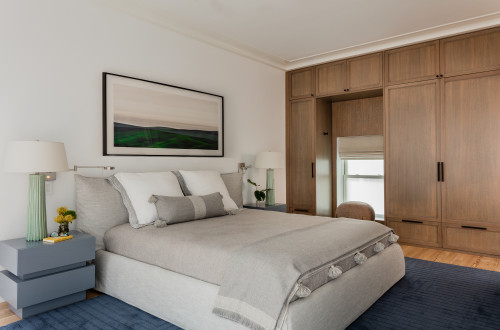
Make your bed a place of comfort and relaxation with good-quality linens, ample pillows, and other pleasing accouterments When you’ve had an especially trying day, there’s nothing quite so restorative as slipping into a freshly made bed. 20 more words
Samhain~Halloween Customs and Practices III What about those horrible Witches everywhere and the annoying Trick or Treaters? This is the time of year that the Scots believed that the Cailleach, the Hag, arises from stone to walk the Earth. She actually had a blue-gray or almost black face. She is an important supernatural being in […]
Top Trends From London’s Decorex Design Fair 2021 Hello, you are invited to visit Wyndesongs and Wyndesong Collectible for Home Decor, Garden Decor, Gift Ideas for both children and adults. 29 more words
Kew Gardens has secured a new world record for the “largest collection of living plants at a single-site botanic garden”. From the longest and biggest to the smelliest and smallest, the Royal Botanic Gardens in Kew’s record-breaking plant collections have long been renowned for being amongst the most valuable and varied in the plant kingdom. […]
Optimism filled the air at Copenhagen’s 3 Days of Design 2021 as iconic brands looked to a post-pandemic future After many months of pandemic-related restrictions, the streets of Copenhagen were unusually vibrant and filled with optimism during 3 Days of Design, the Danish capital’s annual design festival, which took place Sept. 16 to 18 this…Read…
Made from cork, which is a natural and sustainable material, Qurkies are soft yet firm building blocks that can also fit on Lego Duplo bricks. The cork bricks can even be wiped clean with a wet cloth. Looking for eco-friendly building blocks for your kids to play with? Qurkies’ building bricks made from cork may […]
The home design industry is raring to go. After a long pause due to the pandemic, people are hungry for fresh ideas and industry change. At a recent online event, the Heimtextil Trend Council presented its 2022-23 trend predictions for home textiles. The forecast offers a taste of what will be exhibited in January 2022 at the Heimtextil trade fair in Frankfurt, Germany.
The pandemic has highlighted the importance of a comfortable and beautifully decorated home. Textiles play a part, but sustainability is also important. One thing is clear: More of the same is not an option.
Hemp fiber could be a material for the future. Used in antiquity, hemp is easy to cultivate and maintain, grows quickly, is resistant to pests, uses far less water than cotton and produces more biomass than most other cultivated species. All photos by SPOTT for Heimtextil.
The First Steps Are Not Enough
“Sustainability is no longer a choice or a desirable add-on, it’s an absolute imperative,” says Caroline Till of London studio Franklin Till. “The detrimental impact that we’re making on the planet is abundantly clear. So, for individuals, brands and manufacturers alike, having a clear approach to sustainability is of paramount importance.”
And mass production? “We are in a period of transformation,” says Anja Bisgaard Gaede of Spott Trends & Business from Denmark. Bisgaard Gaede, along with Franklin Till and the Stiljinstitut Amsterdam, represented by Anne Marie Commandeur, was part of the trend council that researched and presented the new trends for Heimtextil.
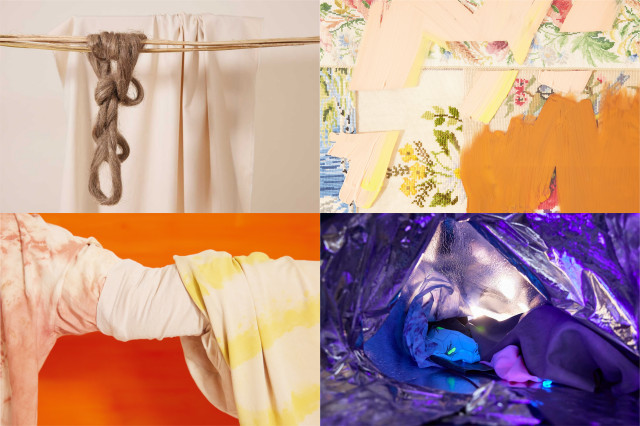
Textile design without chemicals is possible, thanks to natural dyes, sustainable printing, sun printing and digital printing as in this example from VIA University College in Denmark.
“We do still have large-scale production, which we need to change to a more sustainable path. We are looking into serving you … the continued push to do so and the continued inspiration for how to do so,” Bisgaard Gaede says.
“This generation of emerging designers is inviting us to challenge the mainstream discourse surrounding the climate emergency,” Till says. “They’re offering innovative, impactful ideas that align with their strong sense of environmental and social values.”
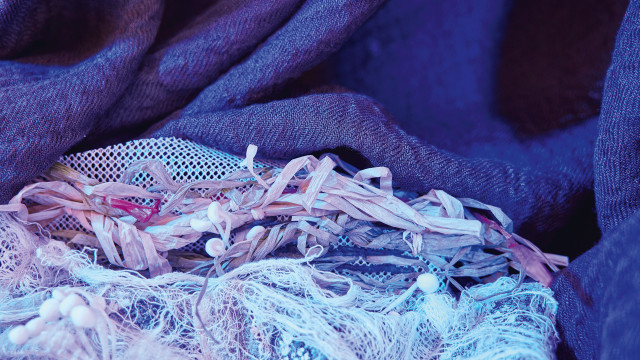
Sustainable textiles do not need to come in earthy colors. Pictured is fabric made out of patterned offcuts and raffia palm ribbon by Christina Engsig.
Radical Thinking
The trend council makes it clear that for a product to be sustainable, it is no longer sufficient to just stick an eco label on it. “We need to think radically differently about production today,” says Bisgaard Gaede. “The future of home textiles is really understanding nature’s intelligent system. … In order to not create imbalances, we need to learn how nature actually balances itself.”
Till presents two possible approaches: “to either retain naturally derived materials within the biological cycle and let them degrade, or utilize only synthetic materials that can be retained wholly in the technical cycle, within infinite loops.”
“The future of objects should simply not create waste or imbalance,” as the trend council’s video statement put it.
Biodegradable textiles out of mycelium, animal innards or agricultural waste, or bacteria that dye textiles naturally, are some examples raised in the presentation. An emphasis on traditional craftsmanship can also fuel a sustainable shift.
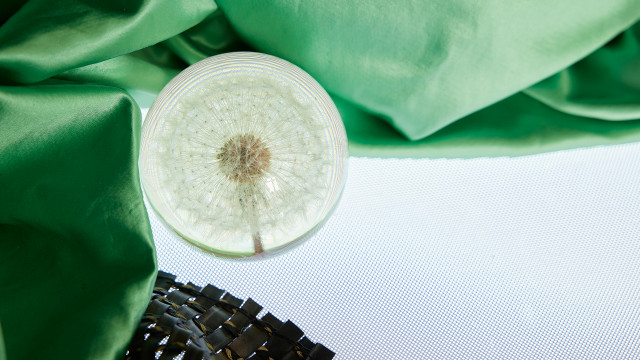
The cloth of the future is responsive. This means it can react and adapt to the environment and the body. Or materials can come into contact with the natural world virtually, through augmented reality. Pictured is reflective textile design from VIA University College.
“In the Western world our disconnection from nature has brought us to this state of ecological imbalance,” Till says. “But we can look to technology to provide a lens to help deepen and strengthen our connection to the natural world.”
Till sees the future in innovative production processes as well as in digital economic goods: products that are not physically present, and which we experience virtually through augmented reality. “People are actually willing to engage and spend large amounts of money — whether it be design pieces for the home or indeed fashion items — that house a virtual space or dress a digital avatar,” she says. “This is … exploring a future in which we … look to fulfill our sense of creativity and our desire to consume within the virtual realm.”
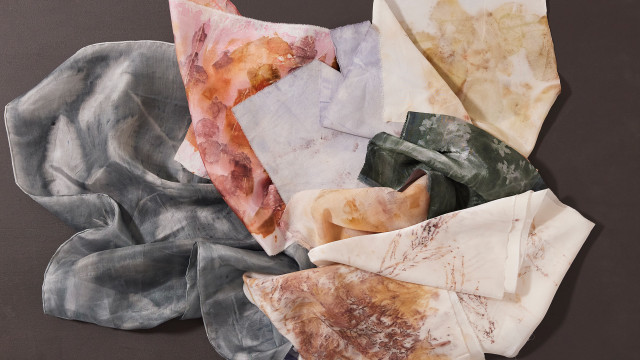
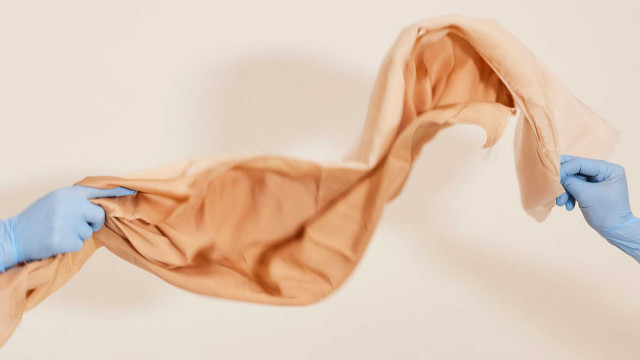
The material in this photo was dyed with onion skins and avocado pits. There is ongoing research into the viability of these methods for mass production.
New Materials for a World Worth Living In
The four trend themes — Deep Nature, Hyper Nature, Beyond Identity and Empowered Identity — are united by one basic thought: They show how the industry can use resources more responsibly in future.
How will this lead to the fabrics of the future, and what might these look like? Here is an overview of the most important colors, materials and technologies for the coming season, put together by the Heimtextil Trend Council.
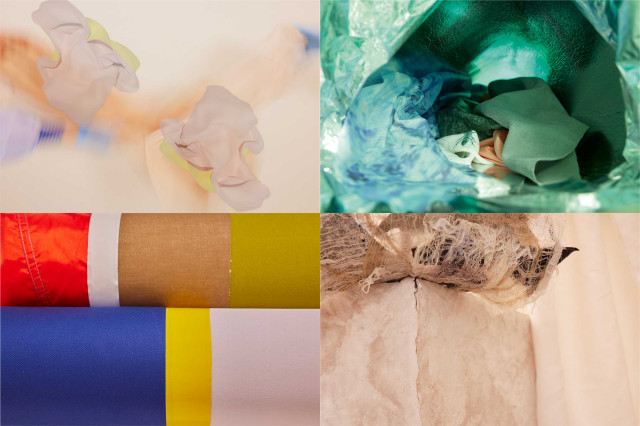
The new world of color, clockwise from top left:
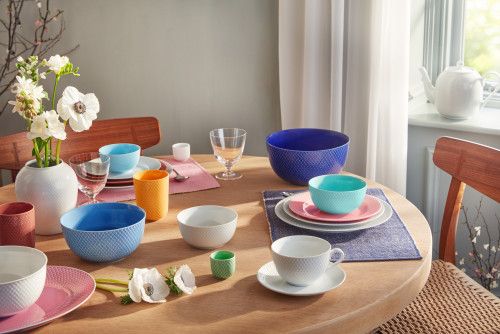
Powerful pastel tones like pistachio, peach and dusty sky blue, mixed softly with neutral tones like gray or light khaki. Bright yellow and orange provide accents.
A lively and hyper-natural palette of unusual greens all the way to intense purple. This includes clear, bright shades as well as diffused green and gray tones. Salmon and raspberry serve as accents.
Essential and organic colors: marshy, botanical tones, dye-free shades like sandy beige or brown. Natural dyes create delicate and dusty blue shades and soft reds.
Traditional primary colors (yellow, red, blue) are expanded with shades of coral, kiwi green and dusty lilac.
The new materials, clockwise from top left:
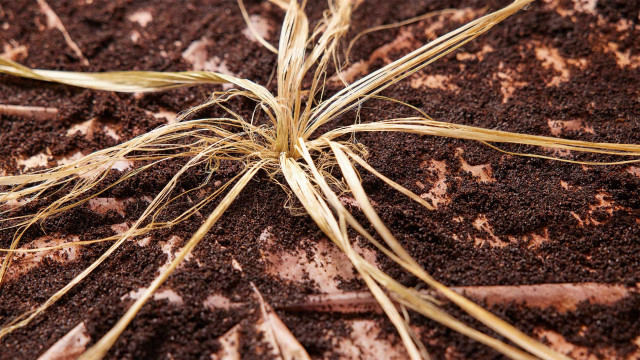
Natural materials and colors that can be obtained, worked and reused in circular processes, like jute, flax, hemp, linen, plant skins, palm leather, coconut fiber, mycelium.
Traditional technologies like tufting, cross-stitch, weaving — or experimental stitching methods. Handicrafts like handwoven tapestries or modern takes on traditional patterns from around the world. Traditional Scandinavian textiles like Fanø scarves, Hestedaekken textiles, ikat kitchen towels or klokkestrenge patterns (pictured), perhaps updated by prints or paint. Traditional wool weaves with repurposed materials. Recycled synthetic fabric.
Responsive materials, recycled synthetics, technical fibers with natural textures, smart textiles, microscopic structures, use of digital sustainable textiles.
Hand-woven recycled polyester, printed digitally or with the use of light technology, which is then easy to recycle again. Using bacteria or natural plant pigments for dying. Pigments that change through use. Puff textiles out of microfibrillated cellulose. Traditional silks.
The Wara Art Festival in Japan’s Niigata Prefecture (all images courtesy the Wara Art Festival via Facebook)
In some regions of Japan, this time of year marks the peak of the annual rice harvest season. Traditionally, Japanese farmers have reused leftover rice straw (“wara” in Japanese), a byproduct of the harvest, to feed livestock and better the soil. Artisans have used it for making tatami mats and other household objects. But over time, technology has replaced these traditions with the utilization of industrial materials, leaving farmers with enormous amounts of dry rice straw for which they have no use.
In the coastal region of Niigata Prefecture, a major rice-growing area, the Wara Art Festival brings a creative solution to this problem: enchanting, oversized sculptures of animals and mythical creatures made exclusively of rice straw. The straw sculptures are designed by students from Tokyo’s Musashino Art University and installed in collaboration with local residents in Niigata. After a year of hiatus due to the COVID-19 pandemic, the festival is now back for its 13th edition, welcoming visitors at the local Uwasekigata Park through October 31.
Founded in 2007, the Wara Art Festival is organized jointly by Niigata City’s local tourism council and the Musashino Art University. It is the brainchild of Shingo Miyajima, a professor at the Department of Science and Design at Musashino, who in 2006 was asked by Niigata’s farming community to think of a solution to the problem of unused rice straw. The professor came up with a creative idea: monumental animal sculptures supported by wooden frames. Since then, the festival has become a major tourist attraction in the region.
Rising from the fields, the mammoth artworks can climb to the height of 30 feet. The exhibition features menacing, sharp-toothed beasts and dragons alongside endearing apes and elephants. This year’s displays also include a representation of an Amabie, a beaked mermaid or merman from Japanese mythology.
Ideal for a family trip, the festival’s Facebook page shows visitors of all ages posing for pictures inside the open jaws of a crocodile or in the lap of a giant gorilla. The festival has only one request from visitors to ensure the safety of the displays: Please don’t fly drones in the park!








 nishadesigns.com