Hi, welcome to Nisha Designs.
Nisha Designs is the design studio of artist and textile designer, Nisha. This is where you can explore my artwork – each painting representing a magickal journey imagined spiritually and reflected physically with every brush stroke – buy paintings, and request commissions.
Nisha Designs is also home to my textiles business. I have 18+ years of experience working in the textile industry for Abercrombie Mills (Cone Jacquard Mill), Opuzen, Steven Harsey Textiles, Koni Hospitality, Welspun, Venus Group.
We provide custom and commissioned art, custom textile designs for hospitality and home textiles, as well as Art Direction services.
Whether its working with luxurious natural fibers – such as wools, cottons and organic linens – to designing your next bedding collection; to capturing the essence of a moment in nature through intricate brushstrokes on a canvas; or gathering nature’s little treasures – like stones, shells, leaves and feathers – to support me creatively in producing mood boards for art direction – Nisha Designs honors Mother Earth in all that we do, and creates with the utmost care and respect for the planet and her resources.
Found this in a small underpass. The colours are gorgeous. Here’s the east side. It is very different from any other native street art I have found. There are a lot of faces on the west side. The faces are in organic things, like tree trunks. I have turtle love. Pics taken by Resa – […] […]
Welcoming Spring with a few of my favorite things. I love springtime in my back yard when the plants are just beginning to show. Here in northern MI things are just beginning to pop out of the ground it is likely to be a few weeks still until there is color and spring greenery but…
DELIGARD upholstery fabrics: unrivaled in cleanliness and easy maintenance. Bacteria, dirt and moisture don’t stand a chance with this pattented innovative system. In hotels, restaurants, retirement homes and clinics textiles create an especially relaxing atmosphere by reducing noise and spreading warmth and comfort. DELIGARD upholstery fabrics have a singular anti-dirt protection; they thus offer protection against contermination which is of great importance in highly frequented public areas. They are the solution for long-lasting stainless upholstery.
Each individual fiber is enclosed by a protective sheath, replacing the commonly used “shallow” surface coating found in other fabrics. The special layer on the reverse side prevents the penetration of moisture and wetness. This innovative technology provides lasting protection against impurities and dirt, and is easy to clean.
Brooks DELIGARD expands this successful series of upholstery fabrics. It is characterised by its discreet graphic pattern and a soft touch. With this combination it not only offers a discreet and modern look, but also gives rooms a cosy atmosphere.
Here is an overview of the DELIGARD characteristics:
resistant to moisture and dirt
breathable
skin-friendly
prevents the growth of bacteria
hydrophobic
urine-resistant
disinfectant-resistant
extremely durable
environmentally friendly and pollutant-free
easy to upholster
particularly soft due to the textile reverse side
Flame-retardant properties: DIN EN 1021 Teil 1, DIN EN 1021 Teil 2, BS 5852 Crib 5, IMO Res. A652 (16)
Walking the path of earth is living in harmony with nature in everything we do. The word nature literally means “that which is born.” When the poet e.e. cummings spoke of the difference between “a world of made” and “a world of born” in one of his most famous poems, he gave voice to trust in nature— recognize that the natural world is our home, our source, and the teacher of the wisdom we most need to learn- Philip Carr- Gomm
The Celtic symbol of the dragon is magical, one of transformation and eternal wisdom. The druids respected dragons as forces of nature, the guardians of mother earth and all things sacred, the protectors of nature and all living things. The dragon holds the powerful Celtic symbol of protection and power. These magical beings represented all that the universe has to offer.
Dragon energy was worshiped and used for the greater good. At special celebrations of the turning seasons of the year, to harvest the right crops, as a true guardian for all they held sacred.
The earth dragon has a symbolism of nature and all things connected to our Mother Earth. The earth dragon asks us to connect with nature in all of its beauty. The true wealth is not money but from the beauty of our land.
Call on the energy of the earth dragon if your energy needs grounding, or if you have lost your way a little, she will reconnect you to true source and bring back your power.
Morag Myerscough is hugely passionate about what she does. Full of energy and full pelt into conversation as soon as I arrive at her London studio – though she admits a couple of coffees were involved – this is mostly her decompressing from presenting to a client that morning. She is passionate about what she does – but what is that? The labels graphic designer, designer and artist have variously been applied, but Myerscough doesn’t care to be labelled. Her website has no bio, and she has no business cards – much to the shock, she says, of a cohort of students she met recently. If you look at her work for clues, one of her best-known projects is a much-photographed wall in London’s new Design Museum, but others include the Temple of Agape on London’s Southbank, a ‘Belonging Bandstand’ that moved around Sussex, bedrooms for the Sheffield children’s hospital, and the 2015 Stirling Prize-winning project of Burntwood School that she collaborated on with architects AHMM.
The Temple of Agape. Image credit: Gareth Gardner
A project she has just presented was Mayfield in Manchester for developer U+I. Mayfield is a formerly derelict site in the process of being regenerated into a mixed-use development and public park. Myerscough’s large installation there displays the common traits in her work: it is a temporary, community-minded intervention in a public space, to be completed in a short deadline. Sceptics might see the combination of developer and artist as an exercise in ‘artwashing’, but there is a history of collaboration between her and Martyn Evans of U+I since a London community project, the Movement Cafe, completed in 2012. Myerscough is confident that what U+I is doing is positive, as ‘they do have a conscience’, and she is careful about who she works with, especially as she becomes better known and people approach her more and more. With developers, she says: ‘There’s always a level of moneymaking … but if you’re not displacing anyone or anything then I think it’s really important that places like Manchester get money put in them by different developers … because, obviously, if the European money gets taken away…’
There is a history of collaboration with U+I since a community project called the Movement Cafe. Image credit: Gareth Gardner
Just as she has to trust the client, they have to trust her. If they do, she ‘will go beyond – far and beyond’. With this trust – and with age too, says Myerscough – comes a sense of freedom and confidence. She no longer feels like a designer fulfilling a brief for a brand, as she explains: ‘Now I’m doing Mayfield, I’m not really responding to it being the brand or whatever; I’m responding to the social environment and all the people.’ It’s a more personal response, ‘a different space where it comes more from me’.
Despite having plenty of experience, Myerscough always looks critically at what she does. She believes it is very important for more established designers to relate to younger generations. With personal growth it can too easily be forgotten that the world is changing too: she talks about the ‘old-school’ and ‘male’ situations still being created by certain, older architecture and design figures, while outside of the industry she laments former prime minister Theresa May being ‘so old-fashioned [as a woman], so wrong in every way’.
One of the best-known projects is a much-photographed wall in London’s new Design Museum. Image credit: Gareth Gardner
Although she frequently collaborates with artist Luke Morgan, Myerscough is a one-woman studio, which she set up in 1993. How she defines herself and her work is important, and she remembers the confidence and ease with which her male peers would start out on their own (Thomas Heatherwick launched his eponymous studio around the same time). Their ease, and her discomfort, was due to rather entrenched attitudes in the industry about gender. She regrets the name slightly – choosing Studio Myerscough rather than Morag Myerscough in order to appear bigger and more established – because she still meets people who are either unable or unwilling to make the connection between her achievements and the studio’s. However, Myerscough prefers remaining on her own even as the projects grow: being the whole of Studio Myerscough gives her freedom with her ideas, time and ambitions, and fewer financial considerations as she hasn’t employees to pay.
Studio Myerscough. Image credit: Luke Morgan
Looking back at Myerscough’s career, you see where the various labels came from. Prior to the studio she studied graphic design, although she has never felt this reflected her work. Professionally, she has been employed as a designer – for Lamb & Shirley post-graduation and then as head of the graphics team for Memphis Group member Michele de Lucci in Milan – before coming back to begin Studio Myerscough. Its first project was a competition for a giant hoarding, which she entered and won with AHMM, and although she never wanted to be an architect the two have worked together on other jobs to much acclaim beside Burntwood School, such as the 2008 Stirling Prize-shortlisted Westminster Academy at the Naim Dangoor Centre, and a new installation in London’s Broadgate development. She was appointed a Royal Designer for Industry, but if she were to describe herself it would be as an artist.
The Belonging Bandstand in Brighton. Image credit: Morag Myerscough
What do you see in Myerscough’s work? For the unfamiliar it is eye-catching: colourful, often large in scale and in the public realm. You can sense her artistic background: her mother was a textile artist, her father a musician, and her family has roots in the circus. She says her penchant for temporary installations is due to the memory of the childhood thrill she felt when the circus came to town – bright colours and gaudy excitement where there was nothing before.
People can be scared of her neons and loud hues, but she uses her experience with colour to challenge those fears. For Sheffield’s children’s hospital the staff initially balked at her multicoloured designs, preferring ‘calming blue and green’. But once ‘they realised we weren’t trying to kill the children’ the mocked-up bedroom designs went down very well with the patients, parents and staff – and, as it turns out, teenagers particularly love orange.
For Sheffield’s children’s hospital the staff initially balked at the multicoloured designs. Image credit: Jill Tate
Sometimes you need to be shown things to understand: Myerscough talks about only realising some of her references for the Temple of Agape project upon walking through the erected structure (such as a temple she visited in India, where light entered beautifully through small openings in the walls).
Myerscough is interested in the difference between looking and seeing – one being passive, the other being active. This affects her approach to working with communities on public projects – considerable impact is made by how volunteers engage with the painting of the piece, able to see it after and say ‘I think I painted that bit’. On that same theme, a festival in Aberdeen called Look Again encouraged locals to reconsider a location in the city called Mercat Cross, which at that time was only frequented by drunks. The project had personal significance for Myerscough because Aberdeen was where her parents met and fell ‘in Love at First Sight’ – the name of the piece she produced for the festival. In among the brilliant team of women running the event, she felt her heritage more keenly than ever, seeing herself as she knew her mum – as a strong Scottish woman.
Myerscough may not like labels, but words are an important part of her work, often appearing large and readable from a distance. These words do not define but hope to provoke conversation. She often likes working with poets, and on Love at First Sight Jo Gilbert contributed with poetry in the local Doric dialect. Myerscough understands that people want to be recognised and appreciated for their unique knowledge and experience, but this can be a challenge for her original vision of a project. In Aberdeen the poem’s 300 words that needed painting were daunting, but Myerscough believes the point of collaboration isn’t to compromise.
Nor is it easy to work with large groups of volunteers rather than a dedicated, trained team, but the rewards are far more valuable, as volunteers treasure the experience. With every project Myerscough learns too – she tells me about how moved she was after a workshop with a blind school, as she never dreamed her work could reach beyond the visual in the way that it did, with the children making ‘incredible’ patterns with stickers and a grid.
At times during the interview I wish she would acknowledge the recognition that different groups want to give her – she inspires architects, designers, artists, nurses, patients, students and more, as their positive feedback testifies. Official accolades are rolling in too: a professorship at UCA Epsom, an honorary fellow at CSM, and a doctorate at Gloucester University, following one she received from Bournemouth, and on top of all this the appointment as a Royal Designer for Industry.
Open and enthusiastic, Myerscough’s heart is on her sleeve, but it is also on the painted surfaces of her work. She could be defined by her many labels and her many awards, but she is most confident in being defined by her work and the responses to it: colourful structures that light up spaces and the faces of those who visit them.
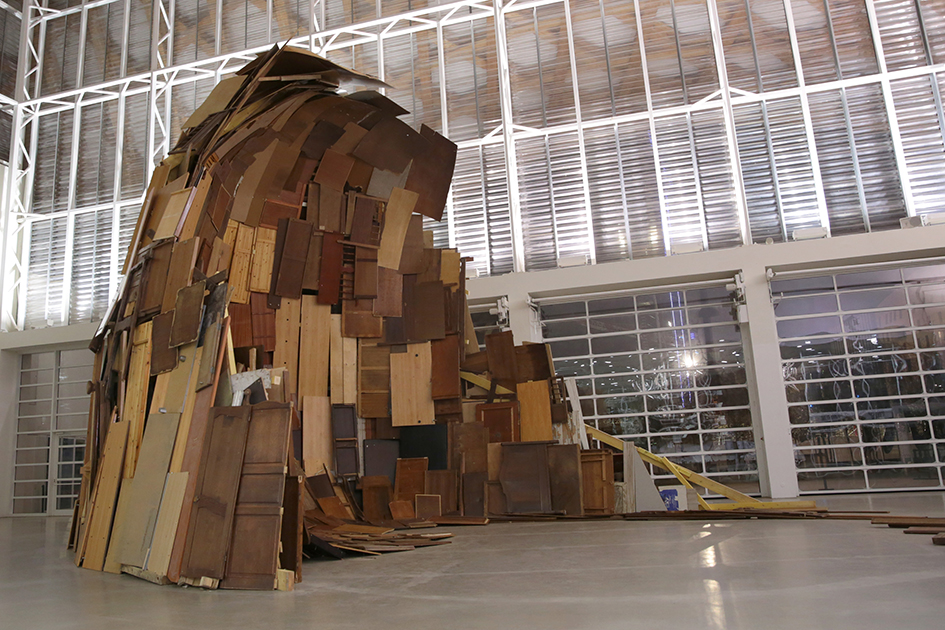
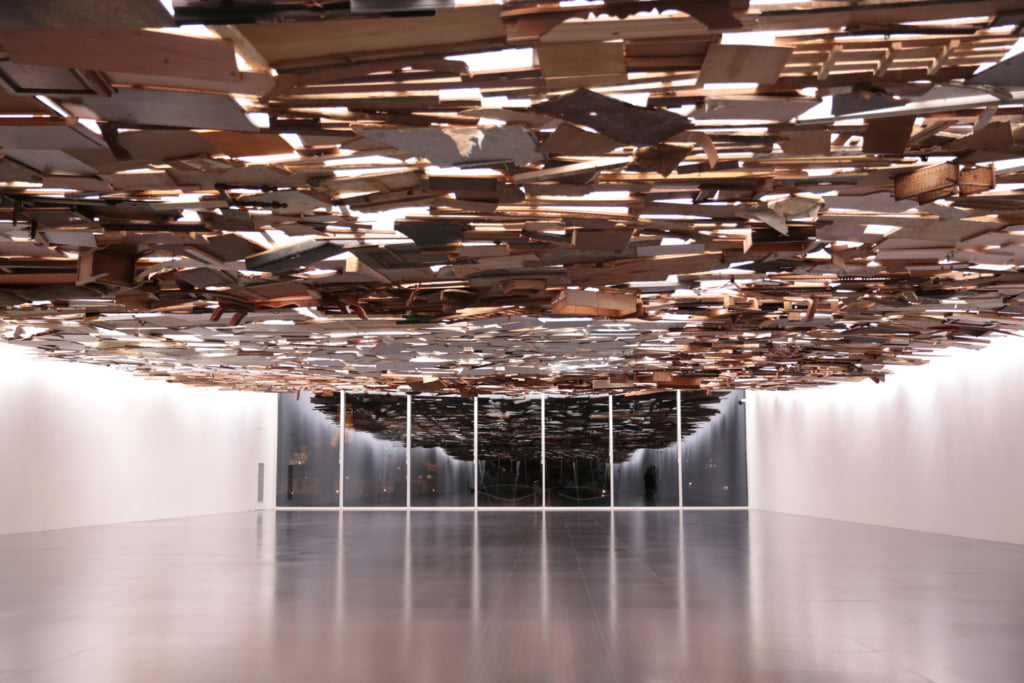
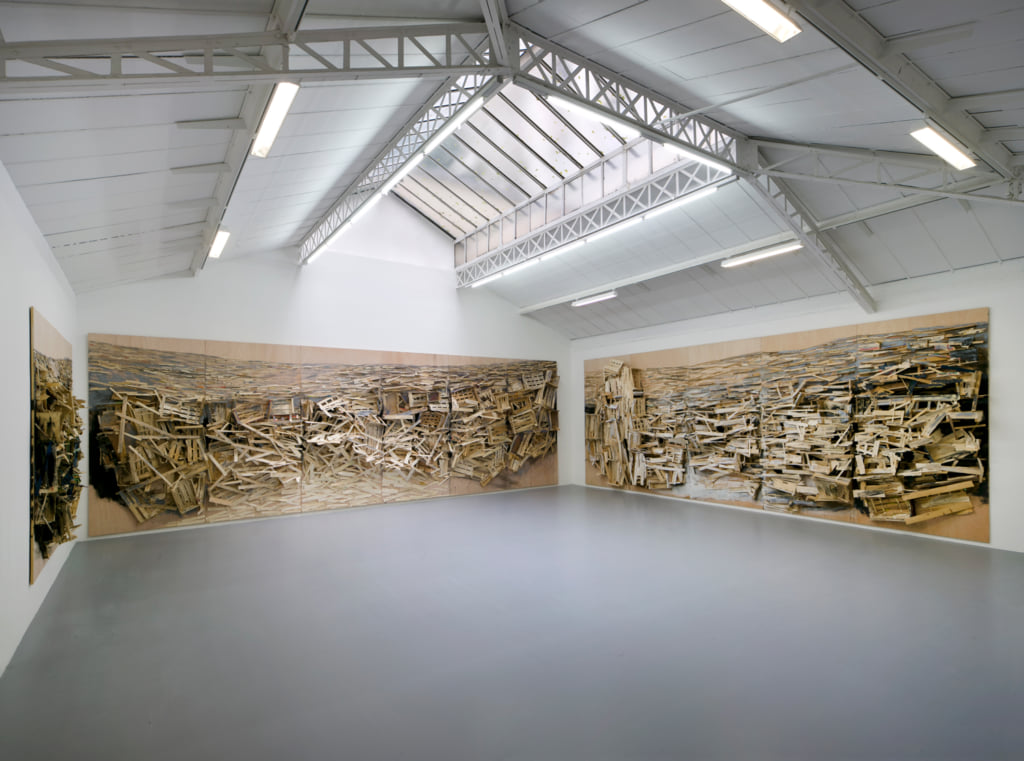
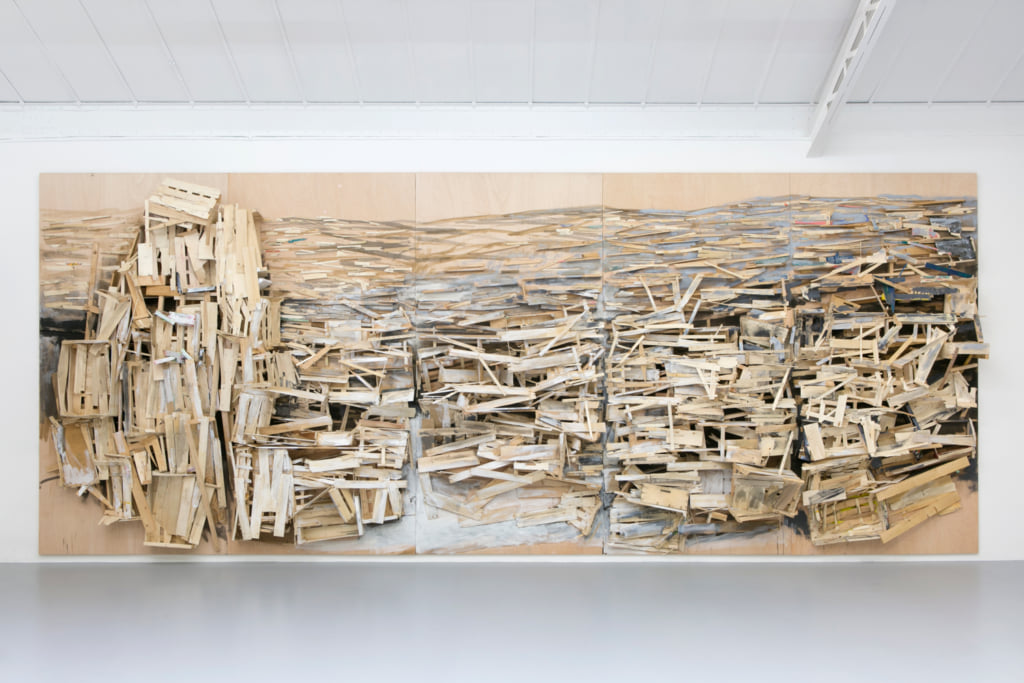
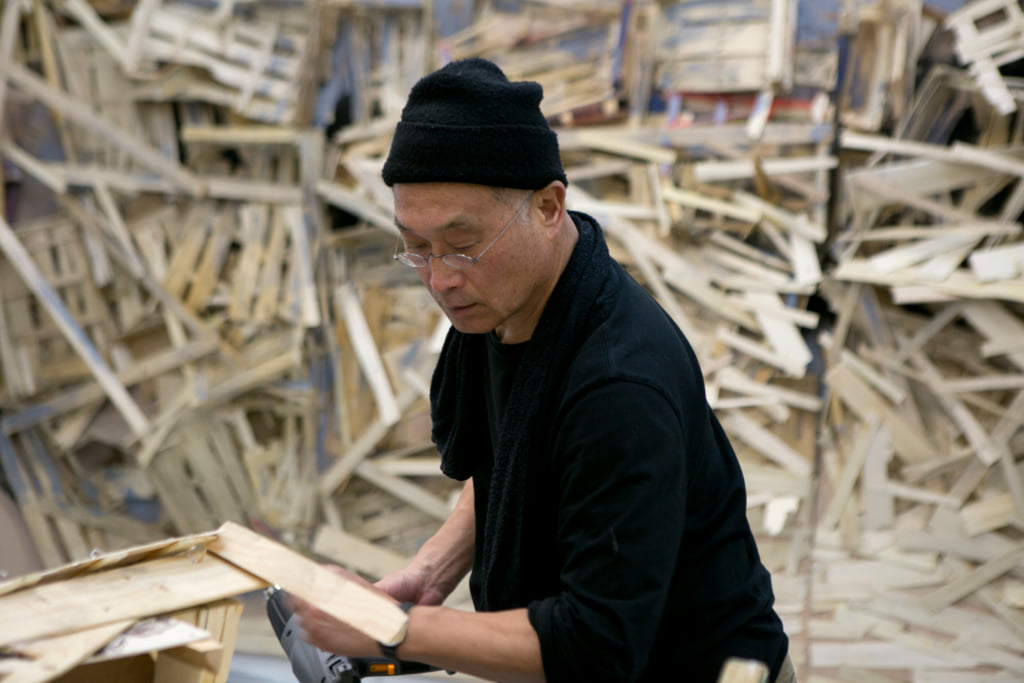
Tadashi Kawamata is a man with a material, wood. With this he builds cabins, observatories, nests and monumental frescos that are at home both in galleries and in the heart of towns and cities. While you might think that the artist, educated at the Tokyo University of the Arts, would use only high quality woods, the reality is rather different. Kawamata instead uses recycled wood from furniture from junk shops, old crates and other left over materials. These recycled materials have been elevated by art, both make for beautiful creative objects, and have a low environmental impact.
The artist works between Paris and Tokyo and began attracting global attention in the 1970s with his in situ works entitled By Land. He installed wood cabins in the most inaccessible parts of New York and Tokyo, such as Madison Square. A few years later he created Les chaises de traverse, a huge pile of wooden chairs suspended between the floor and the ceiling in the Delme synagogue. A few miles the artist also filled the Saint-Livier Hotel in Metz with a wall of chairs. In a short film by Gilles Coudert, the artist explains how each of the chairs represents a different person with a different history, and the wall is as if each of these people were linked together. In 2010 the artist scaled up, setting up a cabin in front of the Centre Pompidou before his chef d’oeuvre at the Renaissance Palazzo Strozzi in Florence.
In 2011 the work of Kawamata took on a new dimension following the tsunami that hit Japan. In Tokyo during the earthquake, he soon left for Paris, while people at home were on the front line helping one another, the artist wondered how he could maintain a link with them. He soon made one of his most emblematic works Under the Water a huge wooden wave recreating the tsunami that ravaged the Japanese coastlines. The work was exhibited at the Centre Pompidou Metz and at the gallery Kamel Mennour where the artist often shows.
Some would like to categorise it as an activist project, but Kawamata firmly rejects the appellation, I’m not an activist, he says, preferring instead to think about the political and social aspects of an issue in a different way. His work would be better described as Land Art, a name given to him when he was appointed the Ordre des Arts et des Lettres in 2014. The contemporary art movement however also uses natural materials but is more oriented towards work that uses nature as its canvas, whereas Kawamata is more at home in the urban or public spaces.
The work of Tadashi Kawamata is marked by its ephemeral nature. His monumental wooden creations both infiltrate and accompany buildings, but are easily dismounted and given a new artistic life.
Nothing is recurring, nothing is permanent states the artist. No material can survive for eternity, everything is temporary. It is just a question of time, even a building that lasts 1000 years is temporary. Nothing is resistant to the wear of time, not men, not walls.
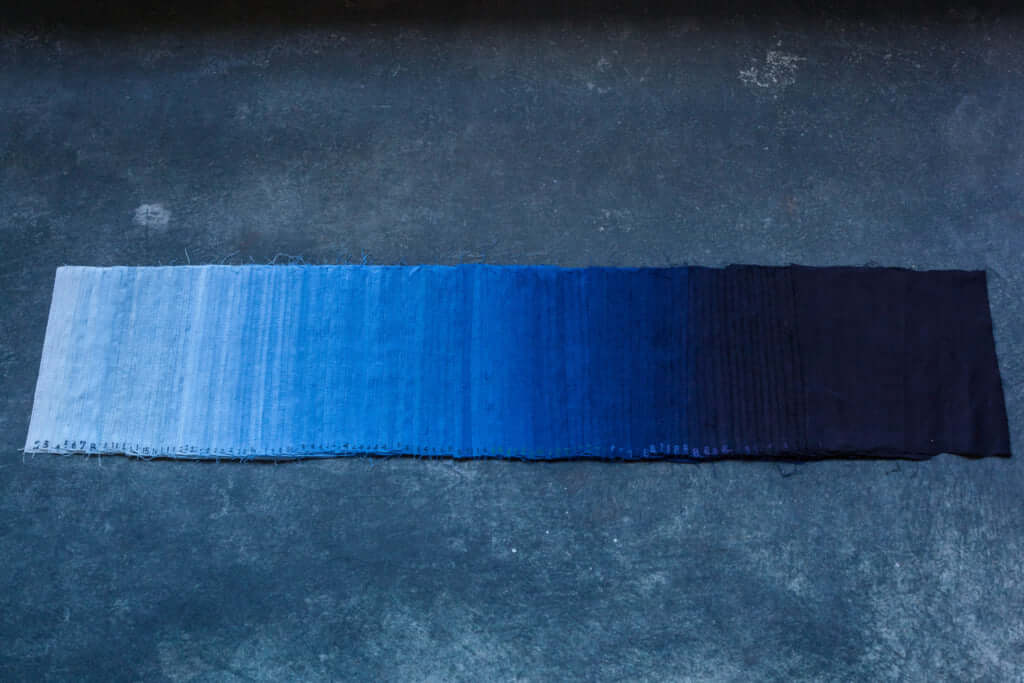
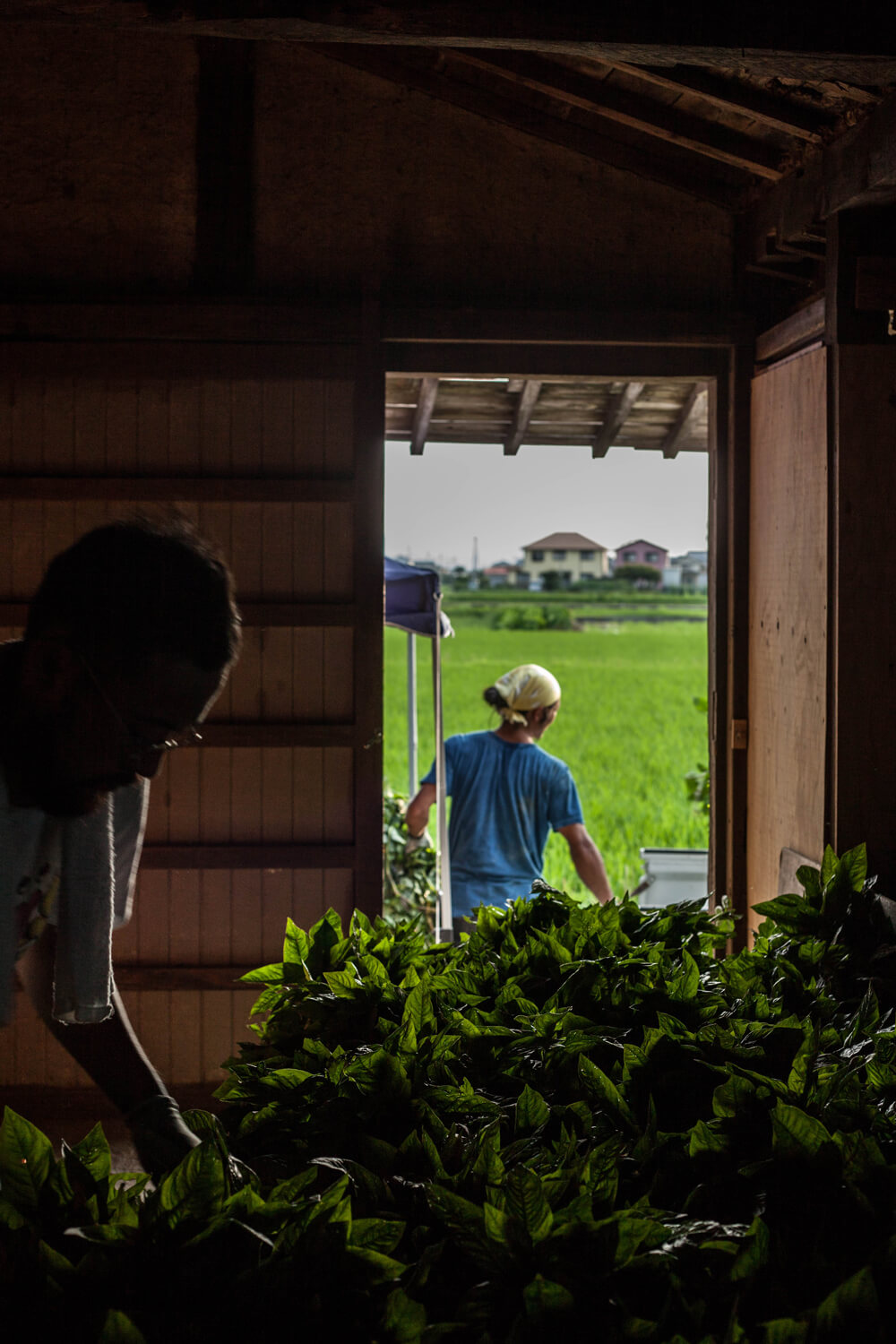
While indigo dye has been produced since the 19th century in Japan, it was only in the early 20th century that it became widespread. It took off most prominently in Tokushima, 600 kilometres from Tokyo on the island of Shikoku. At the time, there were almost 2000 cultivators, today there remain only five. Among them are the craftsperson collective Buaisou, whose mission is to preserve the ancestral art of indigo blue dye.
Buaisou was created in 2015 by Kakuo Kaji who responded to an open call from the Japanese Ministry for Education, offering to train up to two people in the craft of indigo dye. The aim was to preserve this art form before it was lost forever. Buaisou was born, establishing itself as a collective of farmers and dyers who follow through the whole process from start to finish.
‘At Buaisou, we are involved in every step”, says Kaji. “From planting the indigo seeds to producing the dyes and to dyeing the fabric’.
Indigo, the unique art, rooted in Japanese culture
The founder explains how he became interested in indigo dye at the age of 17 years old. ‘I moved from Aomori to Tokyo to study textile design at Zokei University. This is when I first became interested in indigo dyeing. I fell in love with the process and the patience it requires – it is unique compared to other forms of plant dyeing in that it takes significantly more time. It is an art form.’
Today, Buaisou is run by six people. Five craftsmen who are responsible for farming and dyeing, and Kaji, the director of the team. ‘We wanted to create the colour all by ourselves’, he explains. ‘Everything is done on-site at our farm, as much as possible’.
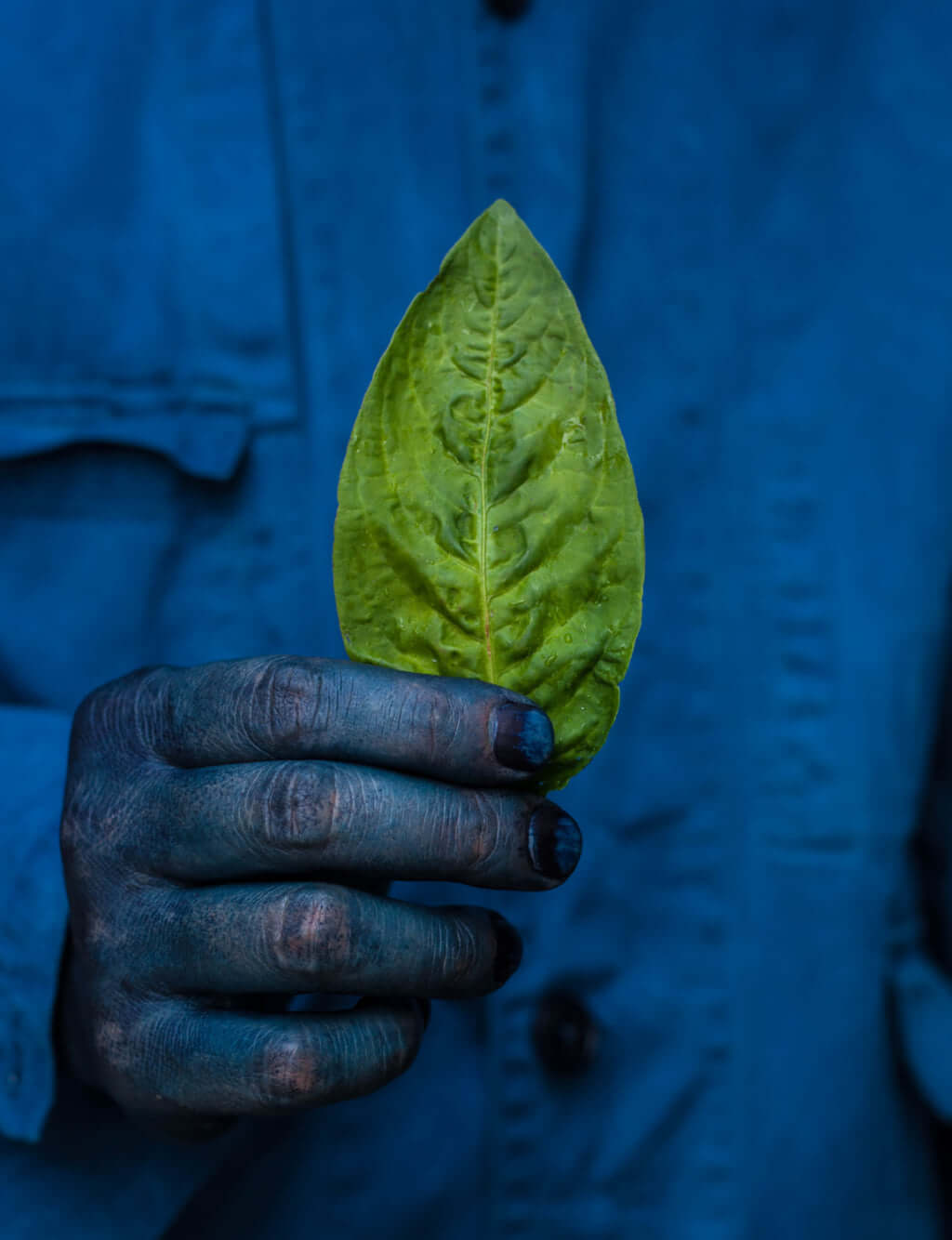
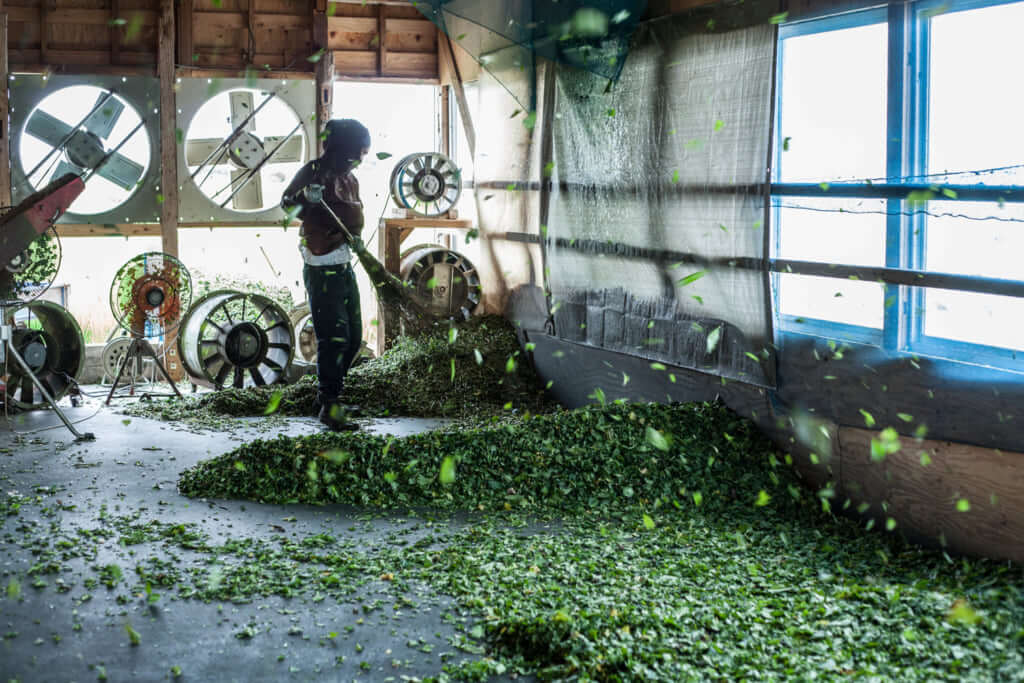
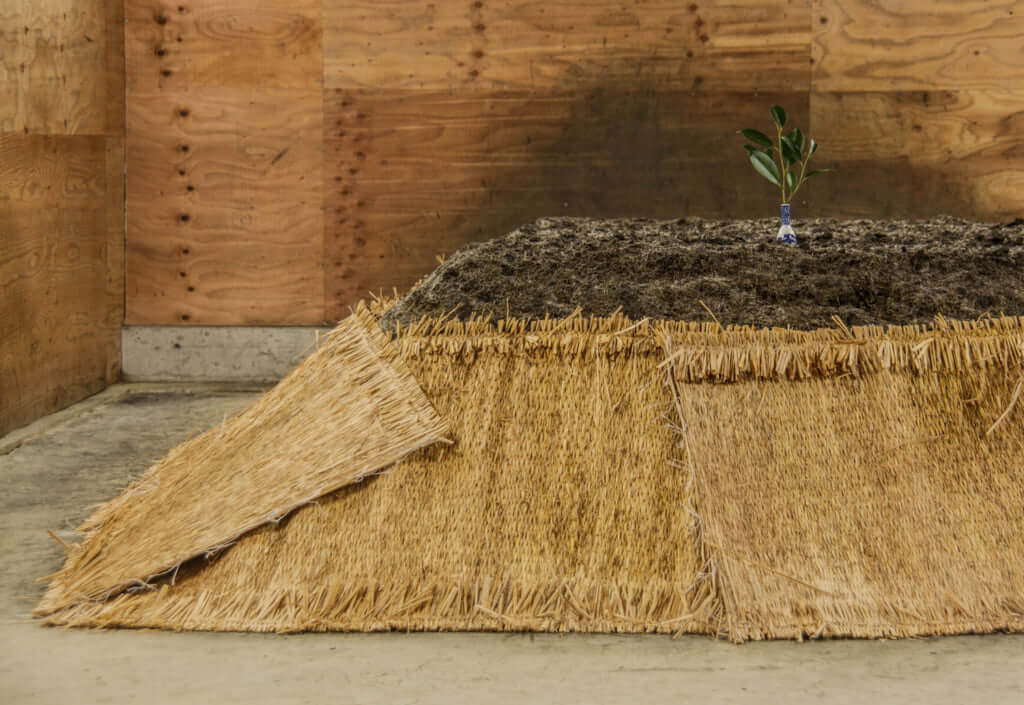
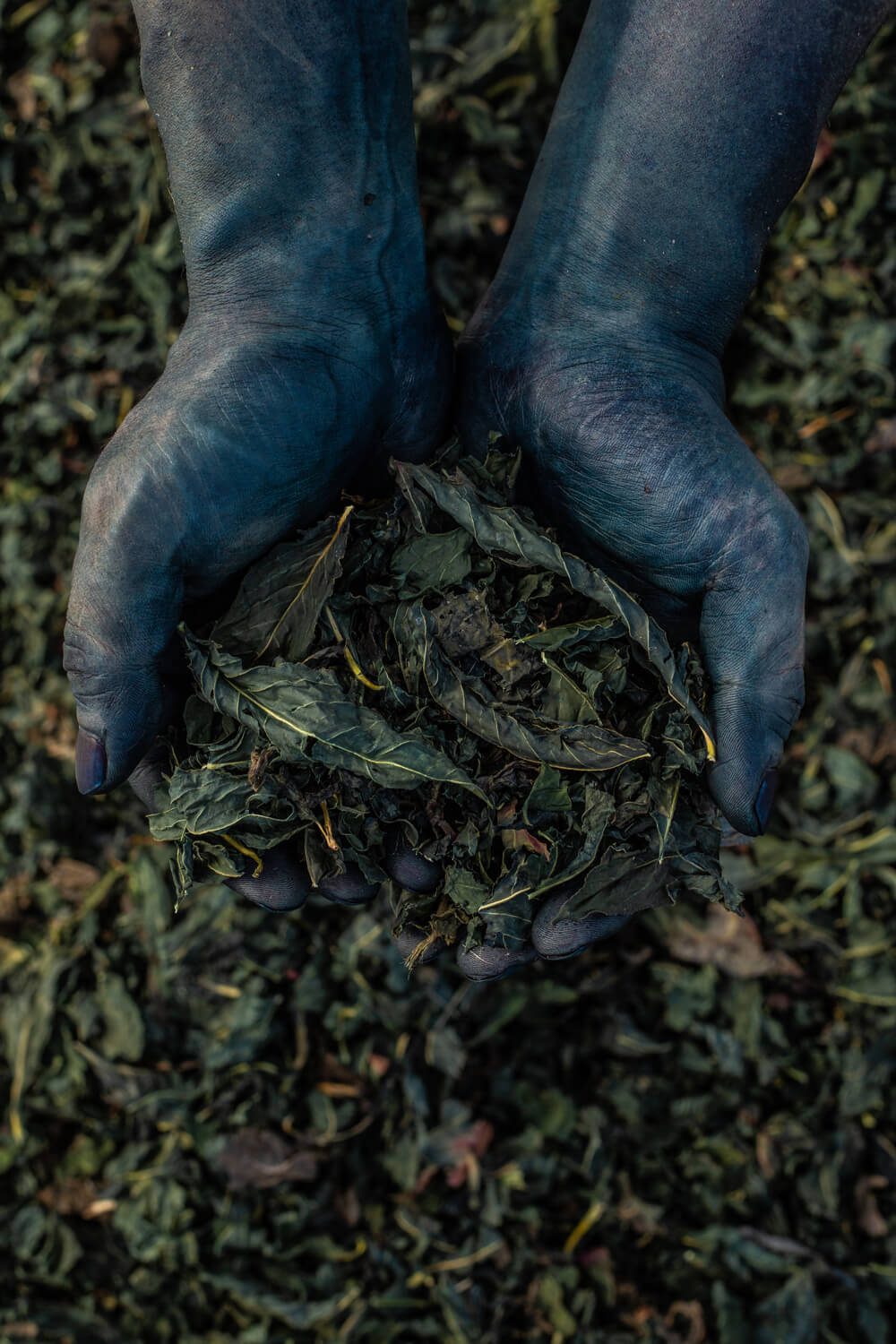
It is a lengthy process which can take over a year and a half to complete, ‘From seeding to finishing composting indigo leaves to make indigo dye (Sukumo), it’ll take over a year. Then we have to dry our indigo dye out, which will take about half a year’, Kaji adds.
With a unique approach, completely devoted to indigo dying, Buaisou attracts worldwide interest, organising workshops with artists, designers, professors, students, tourists and even celebrities such as Kanye West. ‘We have many inquiries from all over the world’, tells Kaji. ‘Most people don’t know what the indigo is. Whether it’s synthetic indigo powder from abroad or indigo paste from abroad, people just call it “indigo”. We’re all about education’. The workshops allow visitors to create the indigo dye only from indigo leaves, lye, bran and shell lime in order to produce a natural pigment which can be used for all sorts of artistic purposes.
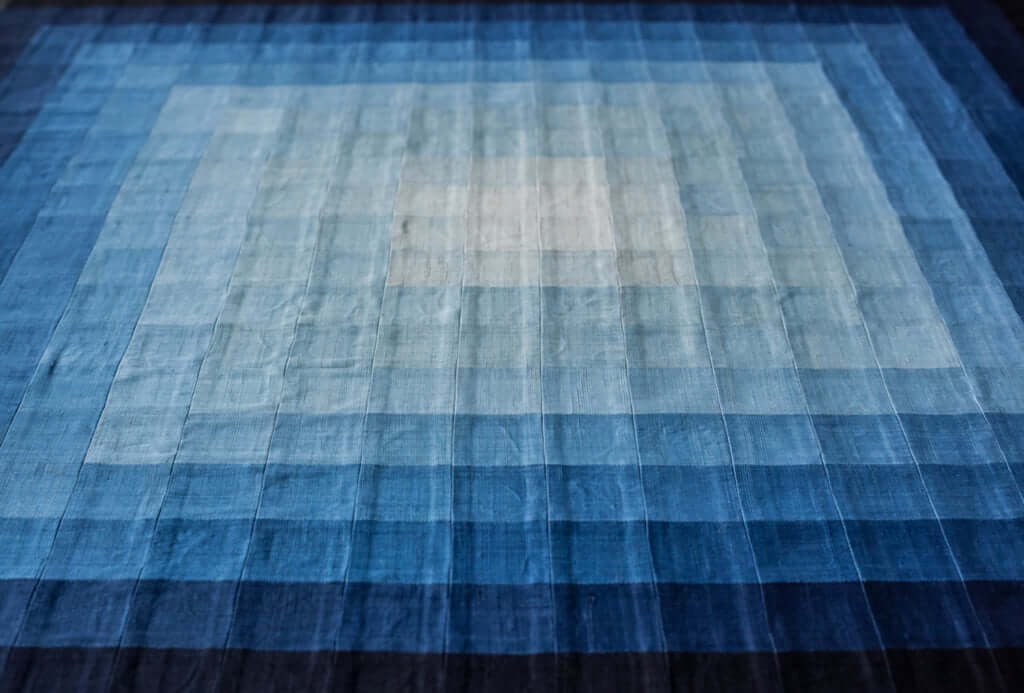
Going from strength to strength, since 2018 Buaisou has been producing their own hand-dyed jeans. ‘Our future goal is to grow our own cotton and weave it ourselves’, says Kaji. This is all part of the broader project of raising awareness about indigo dye across Japan and modernising attitudes in order for the craft to continue to be passed down through generations.
While visiting the Yale University Art gallery (03/20/16) I came across a Yoruba door with four panels. The third panel showed four characters, a tortoise, a man, and a small antelope. I disagreed with the following description, “… a coiled snake seizes an antelope while a small kneeling figure strikes the snake with an axe, […]
These crazy images were created by French artist Jean-Marc Cote, and a few others back in 1899, 1900, 1901, and 1910.
The point being.. Well, basically they were asked to imagine what life would be like in the year 2000. According to Collective-Evolution, these artworks were originally in the form of postcards or paper cards enclosed in cigarette and cigar boxes.
The images depict the world as it was imagined it would be like in the year 2000. Some of these unique illustrations are actually quite accurate vision of the current era today, including farming machines, robotic equipment, and flying machines. Now we haven’t started riding giant seahorses yet, although it does look like one hell of a good time.
NASA researcher turned origami artist Robert Lang quit his scientific career almost 20 years ago to pursue his origami artistry full-time, creating classic nature-inspired designs in intricate detail.
Robert Lang’s origami designs have led to real-life folding patterns that fit satellite dishes and receiving arrays into cylindrical NASA rockets and made airbags in some car designs more compact, practical and safe. Now the California-based artist’s mind-blowing origami takes simple swans, frogs and other classic nature-inspired designs and adds intricately detailed layers.
His work combines aspects of the Western school of mathematical origami design with the Eastern emphasis upon line and form to yield models that are at once distinctive, elegant, and challenging to fold.
Robert Lang’s portfolio even includes mythical creatures including unicorns, dragons, and pegasuses.
Rosa Medea is Life & Soul Magazine’s Chief. She writes about lifestyle including sustainable and green living. She also offers content services to businesses and individuals at Rosamedea.com
Want to sleep in a bubble? If so, I’ve selected 9 places where you can do just that while surrounded by pristine countryside, enchanted forests, or the Spanish desert.
Designed to embrace the great outdoors, these cool bubble rooms are available in various locations throughout Europe and let you fall asleep while gazing at the starry sky.
Hotel Aire de Bardenas, Spain
Nestled in the Bardenas Reales Natural Park, the design-forward Aire de Bardenas hotel offers visitors the opportunity to sleep under the moonlight in beautifully decorated bubble rooms with endless views of the stunning desert landscape. The chic spherical structures are connected by bubble tunnels and come appointed with bathroom, electricity, Wi-Fi, and a minibar.
Forest Domes, Northern Ireland
Escape the outside world with a stay at Finn Lough, a gorgeous lakeside resort offering deluxe bubble accommodation in County Fermanagh, Northern Ireland. Each elegant Forest Dome is stylishly decorated with a bespoke four-poster bed, as well as classy period armchairs and a telescope for stargazing in style. All units come with ensuite bathrooms, Nespresso coffee machines, and 180° transparent walls, immersing guests in the wild surroundings.
The 5 Million Star Hotel, Iceland
There’s no better way to experience the Northern Lights in Iceland than by staying at Buubble, aka The 5 Million Star Hotel. Tucked away in the middle of a secret forest, about 1.5 – 2 hours from Reykjavik, the establishment offers adventurers a variety of bubbles to choose from, all equipped with heating systems, power outlets, and cozy beds to gaze at the starry sky in comfort. Come summer, the Midnight Sun brings the dormant nature to life, painting everything around in vibrant shades of green.
Dome Garden, UK
For a chic back-to-nature getaway in Gloucestershire, look no further than Dome Garden, a futuristic hamlet of 11 eco-friendly dome tents set deep in the Forest of Dean. Often referred to as one of the best glamping sites in the UK, the luxury camping village combines the joys of outdoor life with the comfort and amenities of an upscale hotel. Expect cavelike Hobbity domes, flying beds, entertaining pizza nights, and lots of adventure opportunities right on your doorstep.
ATTRAP’RÊVES, France
Luxury meets outdoor living at ATTRAP’RÊVES, a unique bubble hotel tucked away in the picturesque countryside of Marseille. Here, guests are invited to sleep beneath the stars in inflatable plastic bubbles created by French designer Pierre-Stephane Dumas and furnished with king-sized beds. Each individually decorated unit is conveniently secluded and comes with a completely opaque bathroom and a telescope for stargazing.
Dihan Evasion, France
Dihan Evasion, a quirky family farm in Brittany, lets you spend the night in bubble tents suspended in the hundred-year-old oak and chestnut trees between Carnac and Quiberon, in the Morbihan department. Accessed via ladders, the transparent spheres come with large round mattresses and curtains for a private, comfortable night under the stars. Needless to say, they’re all made of plastic glass, allowing guests to fully enjoy the peaceful wooded surroundings.
Camp Kátur, England
If you are in search of a unique glamping experience in the UK, look no further than Camp Kátur. Situated within Camp Hill Manor Estate, in the rolling countryside of North Yorkshire, the campsite offers an interesting mix of accommodation options, including some unique 360-degree panoramic Unidomes hidden in the woods. This type of unit includes a double bed draped in sheepskin rugs, romantic lanterns, and a gas heater to keep you warm and cozy on cool nights. Outfitted with BBQ, fire pit, table, and chairs, the deck outside is a great spot to just sit and relax while taking in the sights and sounds around you.
Nuit Nature, France
A stay in the bulle at Nuit Nature comes with champagne tasting, complimentary breakfast, and magnificent views of Mont Blanc. Situated in the mountain village of Combloux, the bubble is beautifully fitted with designer furniture and offers a comfortable bed for a memorable night’s sleep outside in the French Alps.
Maison Bulles, France
As if vacationing in Provence isn’t special enough, how about sleeping in a bubble overnight? In the heights of Pont-Saint-Esprit, surrounded by bucolic countryside panoramas, nestles Maison Bulles, a one-of-a-kind lodge where rooms come in the form of transparent, individually themed bubbles. The most special of them is Mercure, which has fiery red decor details and its own private Jacuzzi. Otherwise, all dome-like structures come equipped with comfortable bedding for two and heating mattresses for cooler evenings.
Happy Easter! The Goddess Ostara, or Eostre, a Germanic Goddess is the Anglo-Saxon Goddess of Spring, the East, Resurrection, and Rebirth, is also the Maiden aspect of the Three-fold Goddess. She gave her name to the Christian festival of Easter, whose timing is still dictated by the Moon. Bunnies are a symbol of Eostre, a great northern goddess whose symbol was a rabbit or hare! The season of Oestre is upon the inner child; upon joy, creativity and artistic expression. This is a time to begin new projects, new relationships and explore new territory. This is a time of balance of masculine and feminine within.









 nishadesigns.com