Sculptor and Artist Bruno Torfs’ garden, part of the luscious sub-alpine forests of Australia’s Marysville, is home to a wonderful array of magickal and mystical beings that he himself carved from wood and made using earthenware.
Bruno’s Art & Sculpture Garden, located in Melbourne’s Yarra Valley, has long been a haven for those with a connection to nature and its magickal inhabitants. Among the garden’s residents are a bearded wizard, various fae, a lion, Mowgli, native women, a witch, and Sherlock Holmes and Watson characters.
Bruno Torfs incorporates the natural landscape into his art, using tree branches and leaves as a part of his subjects’ hair or body. After carving, they remain unpainted and blend in with their surroundings.
The South American-born artist’s collection of wooden and terracotta life size sculptures were extensive until the Marysville bushfires of 2009, which tore through much of his garden.
Since the bushfires, Bruno Torfs has rebuilt his home and gallery. The garden has blossomed into a new stage of life, most of his terracotta life size sculptures have been restored and visitors can see his surviving paintings as well as new works in the unique new gallery space.
Rosa Medea is Life & Soul Magazine’s Chief. She writes about lifestyles including sustainable and green living. She also offers content services to businesses and individuals at Rosamedea.com
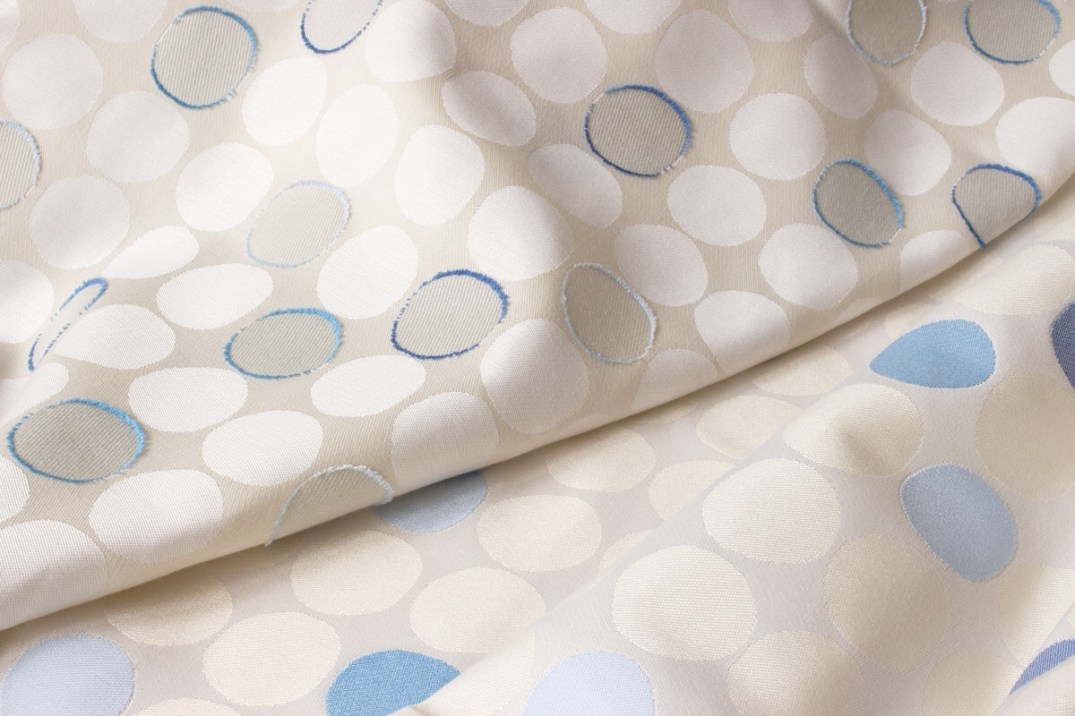
The permanent bio-active functional fabrics by DELIUS offer freshness and hygienic cleanliness. Silver ions which are firmly embedded in the fibre stop the growth of bacteria both within and outside the fibre. They thus protect against infections like MRSA in hospitals. DELICARE fabrics also reduce the formation of odours caused by microbes.
Frequent washing does not reduce the function unlike with normal finishes. This is typical for DELIUS: the function is contained in the yarn and is not subsequently imposed by a finishing process; this also holds true for the flame retardancy.
Frida, Jeff DELICAREFrida DELICAREJeff DELICAREFrida, Jeff DELICAREFrida DELICAREJeff DELICAREFrida, Jeff DELICARE
DELICARE furnishing fabrics
are anti-microbial
prevents the growth of bacteria (hospital bugs, staphylococcus aureus which cause MRSA)
reduce odours caused by microbes
are conducive to a better hygienic standard in rooms
are suitable for industrial washing
have a long lasting wash resistance
conserve energy due to longer washing intervals and a lower washing temperature
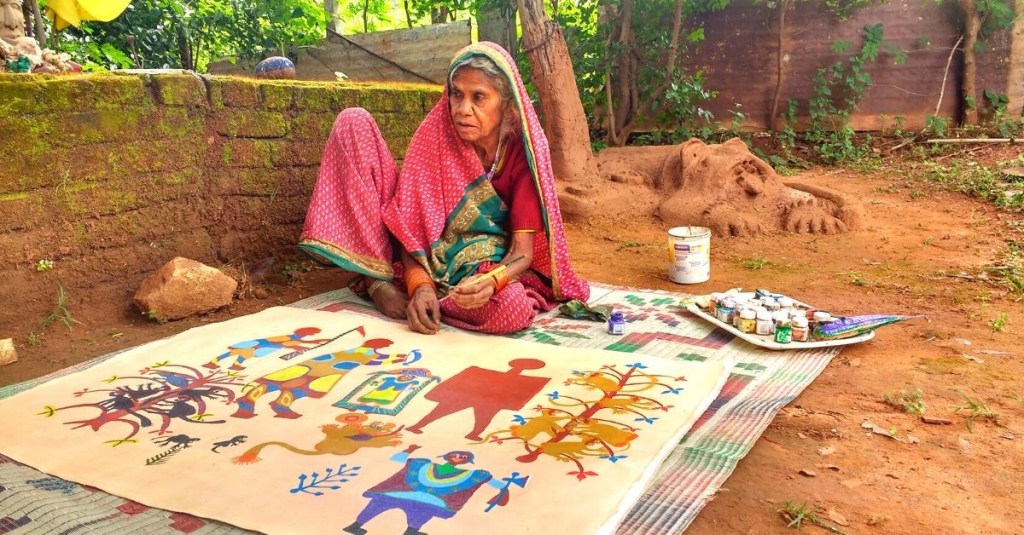
“Painting takes me to another world where I am as free as a bird,” says Judhaiya Baiga. She says this is her way of putting her village on the global map and keeping her traditions alive.
Judhaiya Bai Baiga’s painting recently travelled all the way to a Milan exhibition in Italy and was sold instantly. This was not the first time Baiga’s painting was displayed in an exhibition along with paintings of other talented artists.
A resident of Lorha village in Madhya Pradesh, 80-year-old Baiga who belongs to a tribal community, has the distinction of seeing her art travelling to several art galleries in India and abroad.
“Age or fame has nothing to do with the errors. Perfecting any art is a myth as there is always scope for improvement,” Baiga repeats the sentence from the other end of the phone in case the message was not heard.
Despite being a Diwali week, Baiga is kind enough to oblige for an interview. The excitement to share tales of her village and paintings is clearly evident in her voice.
When asked how she feels about getting international recognition, she says, “It has not changed my life as such. But yes, a change can be seen as more and more women, including my daughter-in-law are taking an interest in painting. Some of these women always wanted to paint but did not have avenues back then.”
How Age Worked In Baiga’s Favour
Baiga belongs to a tribal community heavily dependent on forest resources for their livelihood and some engage in menial jobs. Education, roads and employment are still to reach the interiors of the region.
She lost her husband when she turned 40 and now lives with her two sons. Her only daughter is now married.
Baiga decided to start her second innings with a colourful attitude, literally.
Happy in their world, her community loves to dress in the brightest and most colourful clothes and lead life with the belief that there is no substitute to hard work.
This is probably the reason why Baiga took up painting at 70, an age when most people retire and indulge in rest. But Baiga, who worked in the fields for most of her life, finds relaxation in painting.
“Painting takes me to another world where I am as free as a bird. When I learnt about a teacher who is willing to teach for free in our village, I decided to give painting a try, something I was never interested in. Yet, on the very first day, I found my passion,” says Baiga.
She joined Ashish Swami, a well-known art teacher and an alumnus of Shantiniketan, West Bengal. He runs his studio ‘Jangan Tasweerkhana’ in several tribal belts of Madhya Pradesh to prevent local cultures and traditions from becoming extinct.
“We have such rich cultures across India that are on the verge of dying. Painting is an effective means to save them. By articulating the local practices or customs in paintings, we can also tell other people about local traditions,” Swami tells TBI.
Almost a decade ago, Swami opened a studio in a small room of Baiga’s village. He teaches painting for free and also helps them get fair monetary value through art dealings. Close to 15 local women have been a part of Swami’s classes for the past ten years.
Swami, particularly enjoys teaching people from Lorha village because of their peculiar imagination that colours the canvas.
“Even if they draw something as basic as a tree, their outlook is so different from the rest. They manage to capture innocence in wild animals and serenity in clouds. Their definition of a perfect nature lies in the harmony or co-existence between trees, birds, animals, water bodies and humans,” he explains.
Initially, Baiga and Swami would be happy with whatever amount the painting would be sold at. But soon, they realised the value of the paintings and stood firm on their quotations.
“Paintings are sold on craft and not on how creative they are. We are trying to change that and promote creativity by taking the painters to exhibitions that take place across India. Currently, paintings by Baiga are valued anything between Rs 300 to Rs 8,000,” he says.
While Baiga is content with the money her paintings are making, it is not the motivating factor behind her passion. For Baiga, its her way of putting her village on the global map and keeping traditions alive.
People like Baiga prove that there is no age to learning, and even nature can educate, one only has to be receptive.
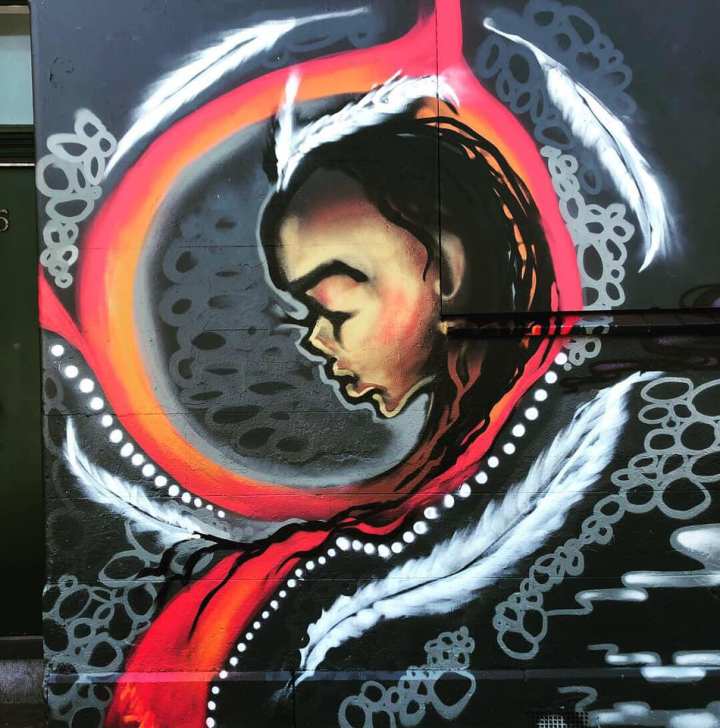
Narisha “Nish” Cash, an Aboriginal self-taught female graffiti artist from Adelaide, is challenging the misconception that the world of graffiti and street art is a “man’s world”.
The Jingili and Mudburra artist has been a regular on the street art scene in the South Australian city since the 1990s when at the age of 15 she first started paving street walls with her work. With her tag ‘ISHK’ (the sound of a spray can), her art has evolved over the years to include themes of femininity, colour and form, nature and her aboriginal culture.
In an interview with SBS, she said: “I usually paint strong powerful women with elements of strength and tough qualities through guns, bandanas, and piercings. What appeals to me of the female form is that it’s the giver of life, its Mother Nature, its beauty.
“I’ve always been surrounded by strong women and it’s important for my characters speak that. There’s a lot of strength around being a woman, especially an Aboriginal woman.”
After becoming a mother, Narisha Cash saw the opportunity to channel her creative practices into a career. She also used her art as a form of healing to overcome obstacles she encountered as a teen and young woman growing up in Adelaide.
She said: “When I started out doing graff there wasn’t a lot of females out there. I’d never thought I’d make a living out of it.”
Inspired by hip hop and breakdancing culture also, it was the artist’s foray into grafitti that opened her up to delving into breakdancing, DJing and MCing.
A well respected and maternal figure in communities across Australia, Narisha Cash also works as Community Arts and Youth Engagement Officer at Tandanya National Aboriginal Cultural Institute. She shares her knowledge as an artist with youth groups and engages them through art workshops, developing and creating public art murals and opportunities for emerging artists and young people at risk.
Taking graffiti art in the context of the coded language of the streets, the Aboriginal artist, with her unique and feminine style of aerosol art, relates her practice to her ancestors creating art work – storytelling, culture and symbolism – to communicate through their natural surroundings.
Narisha Cash believes that grafitti has the ability to connect young people, especially indigenous youth who feel disconnected to culture, in a way that inspires, empowers and educates.
She told SBS: “It gives them something to do that’s positive, rather than turning to grog (alcohol) or drugs, enabling kids to turn to music, dance, painting.
“In our culture, we have the dance, music and arts so it’s important for young people to get themselves out there and be that next generation to get out there and carry that positive torch on and be positive with their outlet.
“I think it’s important for young people to have a variety of ways to express themselves, be it creating public art or transporting spaces into something beautiful.
“I want kids to get an inspiration to get a career in the artistic field and follow my footsteps…I think it’s important for youth to see Aboriginal people doing good things.”
Rosa Medea is Life & Soul Magazine’s Chief. She writes about lifestyles including sustainable and green living. She also offers content services to businesses and individuals at Rosamedea.com
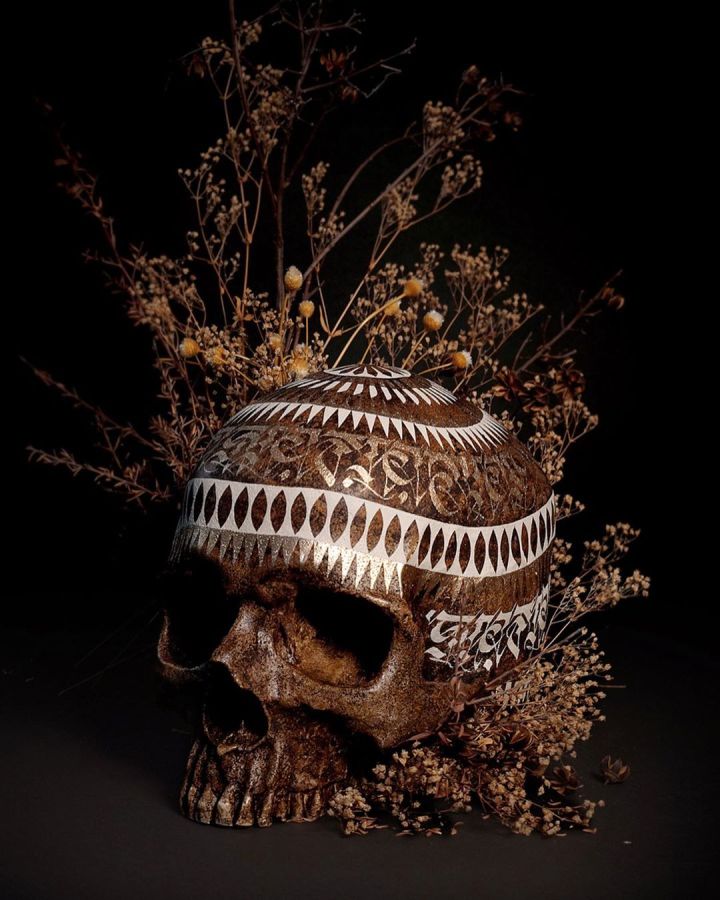
LA-based artist Cryptik explores impermanence – a world beyond notions of life and death – in his first solo exhibition, Impermanent Nature.
In Impermanent Nature, which is currently on display at Galerie Itinerrance in Paris until 19 October, Cryptik takes the law of nature – “all that exists is impermanent; nothing lasts forever” – as his starting point to honour the cycle of life throughout the exhibition.
“It is a search for wisdom and beauty in the transient with the understanding that through anicca all things are possible. From the birth of stars, to our beating hearts, to every breath we take, anicca is what allows life to happen – impermanence is life.
“By deepening our insight into impermanence, we can discover a world beyond notions of life and death, where there is no-birth and no-death, only continuous becoming. All physical and mental phenomena are transient, they come into being and dissolve away. Attachment to things that are impermanent and changing ineviteably leads to suffering.”
“It is a search for wisdom and beauty in the transient with the understanding that through anicca all things are possible. From the birth of stars, to our beating hearts, to every breath we take, anicca is what allows life to happen – impermanence is life.
“By deepening our insight into impermanence, we can discover a world beyond notions of life and death, where there is no-birth and no-death, only continuous becoming. All physical and mental phenomena are transient, they come into being and dissolve away. Attachment to things that are impermanent and changing ineviteably leads to suffering.”
“We must cultivate and nourish our insight into impermanence if we are to live more deeply and suffer less,” Cryptik added. “Through observation and understanding we can experience the nature of impermanence and release ourselves from the sorrows of human life, achieving liberation from the process of anicca.
“’Behold, O monks, this is my last advice to you. All component things in the world are changeable. They are not lasting. Work hard to gain your own salvation.’ These were the last words of the Buddha.”
Cryptik’s exhibition Impermanent Nature is currently on at Galerie Itinerrance in Paris until 19 October
Rosa Medea is Life & Soul Magazine’s Chief. She writes about lifestyles including sustainable and green living. She also offers content services to businesses and individuals at Rosamedea.com
Brisbane’s biggest display of women’s street art, Women’s Work, is taking place at the Outdoor Gallery Exhibition from now until 1 December 2019.
Curated by Brisbane Art Matriachs! (BAM), a collective of up-and-coming female arts leaders working towards bridging the gap for women exhibiting in public spaces, Women’s Work celebrates the empowering artforms and originality of female creatives through a series of outdoor installations, guided tours and talks. This exhibition is grounded in the belief that the work of all women, within the realm of the domestic and beyond, is invaluable.
Among the artists exhibiting are contemporary Aboriginal artist Rachel Sarra whose colourful artwork, on display in Brisbane’s Irish Lane. Her piece, entitled Energy, is a gorgeous mix of shades of pink, purple, blue and orange, depicts dynamic energies radiated by creative women.
Artist and illustrator Mosessa, who is influenced by nature and inspired by mythology and folklore, has her Botanic Beast series showcased in King George Square, featuring floral motifs symbolising womanhood with an Australian twist.
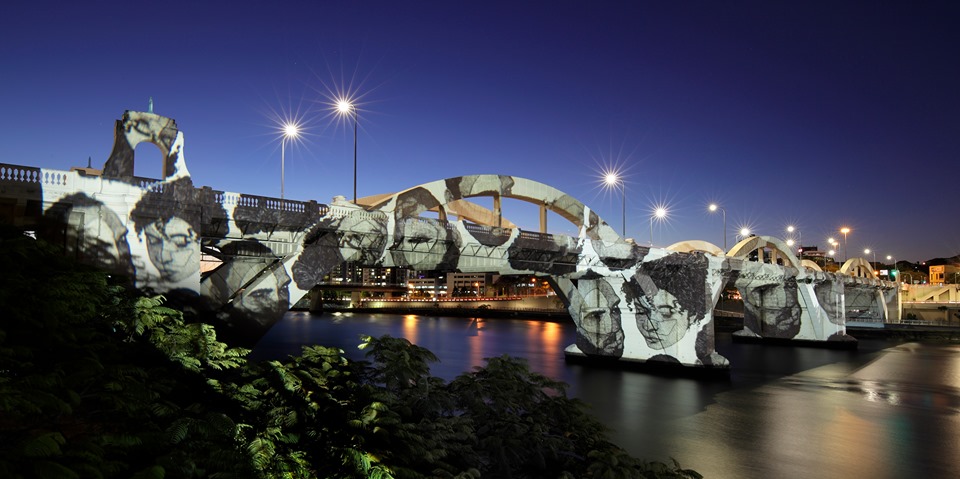
Women’s Work also features artwork from Tori-Jay Mordey, an emerging Indigenous Australian illustrator and artist. Her artwork entitled Siblings 2, which was projected onto the William Jolly Bridge for five nights, is a combination of copper etching prints that features a portrait of the artist herself and her brother with parts of their faces harmoniously merged with their parents.
Tori-Jay Mordey said: “Growing up in a diverse family with our mother being Torres Strait Islander and our father being English, it became clear to me how different we all were, but at the same time I wanted to emphasise how similar we are too. Because it’s not as simple as saying we’re different because of skin colour.”
Brisbane City Council’s Outdoor Gallery transforms Brisbane’s laneways and city streets into imaginative, curious and engaging spaces. Comprising light boxes, banners, vitrines and evening projections, the Outdoor Gallery displays art outside in city streets, instead of inside on gallery walls.
Women’s Work is on display at various outdoor spaces in Brisbane, as part of the Outdoor Gallery, until 1 December 2019
Rosa Medea is Life & Soul Magazine’s Chief. She writes about lifestyles including sustainable and green living. She also offers content services to businesses and individuals at Rosamedea.com
If you have a strong resonance for birds and the air elemental, Shovava’s handpainted and digitally printed scarves will certainly give you wings.
The Australia-based label is the creation of designer Roza Kamitova. Inspired by the incredible beauty of nature, the artist’s observations are meticulous and detailed as reflected in her bright, intricate and graceful depictions of various birds and their feathers in Shovava’s Wings Scarves range.
Roza Kamitova says: “I observe nature and find inspiration in the smallest details. Maybe it’s a butterfly’s wing or the patterned cell structure of a leaf. Maybe it’s a feather or a raven perched on a tree limb. I take in what I see in the natural world and then create my pieces.
“My ideas are born of long solitary walks in the jungle, through bristling fields or along almost pin-drop quiet stretches of sand. I have many kinds of birds visiting me everyday. My scarves are created using age-old artists’ techniques of craftsmanship and painting combined with the marvels of the latest technology.
“Shovava’s trademark winged scarfs reflect that soaring imagination and embody a sense of individuality, power, freedom, and adventure.”
Made from natural materials including silk and cotton, Shovava ensure that their materials are ethically sourced and use recycled materials, where possible. While Roza Kamitova creates the designs in her Byron Bay studio, a team in India print the scarves using digital textile printers.
Shovava was born in 2011 out of the desire to create “unique and thoughtful pieces of wearable art” for women who had “grown tired of the assembly line ‘cookie cutter’ designs” that are prolific in the fashion world. Having spent eight years working in the fashion industry in New York, the nature-inspired designer Roza Kamitova began selling handmade and hand painted tops made from recycled men’s tees on the streets of New York, before her move to Byron Bay began her journey with Shovava.
In addition to the Wings Scarves, Shovava also sells a range of swimwear, mens and womens t-shirts, skirts, leggings and dresses in nature prints via their online store.
Rosa Medea is Life & Soul Magazine’s Chief. She writes about sustainable lifestyle and green living for publications, and offers content services to planet-friendly businesses. Find out more at Rosamedea.com













 nishadesigns.com