The best ice hotels, igloos and snow villages open in 2020- Lonely Planet- Nisha Designs

Cozy up in the coldest hotels in the world © Iglu Dorf / Massimo Cappuccio

In longitudes where long johns are all but compulsory and rugged alpine regions where the snow tumbles down sideways, creative grizzled folk brave the cold to cut and chisel and craft chunks of frozen water into sparkling ice hotels, uplit overnight igloos and snow-covered villages for mere non-mountain mortals to sleep over. 

Iglu Dorf – Gstaad, Switzerland 

Built using traditional igloo techniques, but with tunnels connecting each of the 11 rooms, it takes around 3000 hours to create the Iglu Dorf hotel in GstaadSwitzerland each winter. With breathtaking views out across the crucible of the vast Bernese Alps and its crown of fir trees, this slice of wonderful isolation can be enjoyed by up to six guests in a room overnight. 

With a sauna and swimming pool just outside as well as homemade mulled wine and a traditional hot cheese fondue, this is Switzerland in its purest mountain mode. Iglu Dorf also builds overnight igloos in Davos-Klosters, Stockhorn and Zermatt in Switzerland as well as on Zugspitze in Germany, and the Kühtai ski area in Austria.

Design Ekaterina Barsukova and Vladimir Barsukov _ Photo Asaf Kliger _ © ICEHOTEL www.icehotel.com.jpg
Ice sculpture in a hotel suite, designed by Ekaterina Barsukova and Vladimir Barsukov © Asaf Kliger / ICEHOTEL http://www.icehotel.com

Icehotel – Jukkasjärvi, Sweden

First built in 1989 in JukkasjärviSweden, this is the original Icehotel. It’s crafted annually from 2500 two-ton blocks of snice (snow and ice) plucked from the vast meandering Torne River. At the end of the season it simply melts and the water returns to the river. But whilst it’s up, its shimmering catenary arches and individually-designed rooms with snow statues and ice artwork make it a startling imaginative triumph. 

Located in northern lights territory, high up into the Arctic Circle, guests can also try husky sledding, snowmobiling and snowshoeing. For the artistic, there’s ice sculpting as well. Can’t wait for winter? The Icehotel 365 offers 20 suites, an ice bar and an art gallery all year round. Plus it’s run entirely on renewable energy.

Snowhotel suite.jpg
Snuggle up in your suite © Kaisa Siren / Arctic SnowHotel

Arctic SnowHotel – Rovaniemi, Finland

Rovaniemi‘s Arctic SnowHotel is in Lapland, where Santa Claus kicks back for 364 days each year. Standing on the toes of the Arctic Circle, this part of Finland cycles through eight seasons, but it’s the sparkling magic of winter that’s most alluring: a calming white-scape of thick, crunchy snow; the swirling purples and greens of the northern lights; the excitable yap of huskies waiting to pull their sledges.

But hidden amongst these miles and miles of white wilderness is Arctic SnowHotel, a fully-functioning 30-room igloo that’s built afresh each winter using ice from the nearby Lake Lehtojärvi. The bedrooms are built of snow and ice, as is the bar, the restaurant and the chapel. Snow saunas and outdoor hot tubs also help make the most of this winter wonderland. 

Arctic SnowHotel is open December 15–March 31.
_FRI6086.jpg
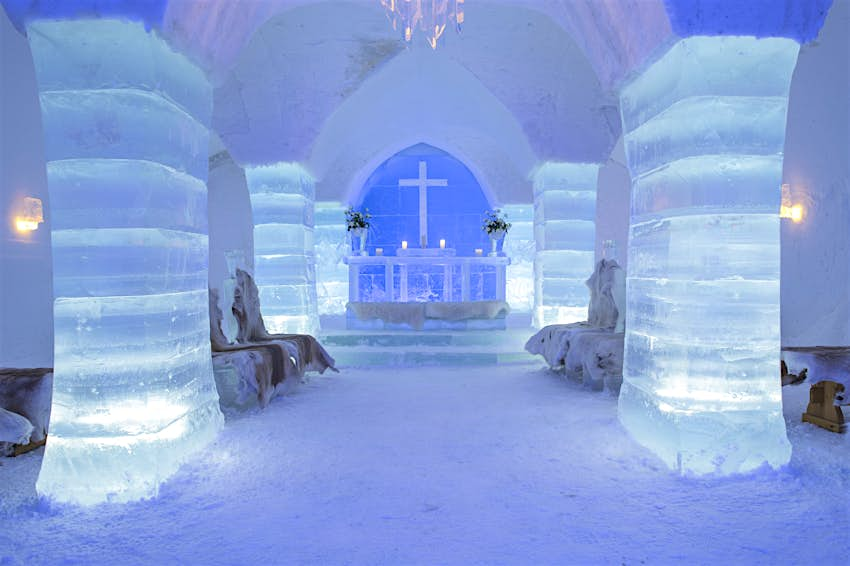
You could have a frosty wedding ceremony © Sorrisniva Igloo Hotel / Frank Rune Isaksen

Sorrisniva Igloo Hotel – Alta, Norway

Sculpted deep beneath the magnetic gaze of the aurora borealis, the world’s northernmost ice hotel in AltaNorway, is also one of the biggest. Some 250 tons of ice and 7000cu meters of snow are used each year to freshly carve its 20 double rooms, three family rooms and five suites.

Located on the banks of the Alta River, a short snow sled from the Cathedral of the Northern Lights, the Sorrisniva Igloo Hotel also has uplit ice sculptures, an ice bar and even its own ice chapel for couples hoping to melt hearts. The beds have reindeer leather as a natural sleeping mat and sleeping bags capable of withstanding temperatures of -22°F (-30°C), but the sauna (no, not located inside the ice hotel) opens at 7am each morning. Just in case.

Sorrisniva is open December 20–April 7.

SnowVillage – Kittilä, Finland

Created from 350 tons of crystal clear natural ice and 20,000 tons of snow, this extravagant SnowVillage in Kittilä, some 125 miles (200km) into the Arctic Circle, is crafted with the care and precision of a medieval church. Decorated with ornate ice sculptures that change year-on-year, each work is lit up in the swirling colors of the aurora borealis. 

As its name suggests, this isn’t just an ice hotel. There’s a restaurant made from glacier-clear ice, a chiseled ice bar that gleams like a diamond, and a beautiful ice chapel too. Each snow suite has been individually designed and brought to life and, yes, there are saunas nearby as well.

SnowVillage is open from December 21–April 4. 

Hauptiglu 9 2014.jpg
Keep warm in the on-site snow bar © Schneedorf Igloo / Frank Neuner

Schneedorf Igloo – Hochötz, Austria

The Ötztal in Tyrol is one of those striking Austrian gram-oramas: a sweeping valley of glittering chalets dwarfed by the brooding dark hulks of snow-covered schist and gneiss striding starward. But up here, nestled some 2670ft up the mountainside in the ski region of Hochötz, you’ll find Schneedorf Igloo. Beneath what looks like a fresh dump of plump white snow is actually a hotel with enough room for 44 people to survive a blizzard overnight.

The silence is rejuvenating at night as the temperatures drop and the constellations start to twinkle against winter’s blueberry-dark sky. Dinner is gooey cheese fondue and the on-site snow bar has enough potent liqueurs to keep guests warm until sunrise. Thankfully, the igloo toilets here are heated.

Schneedorf is open Wed–Sun from December 26–April 4.
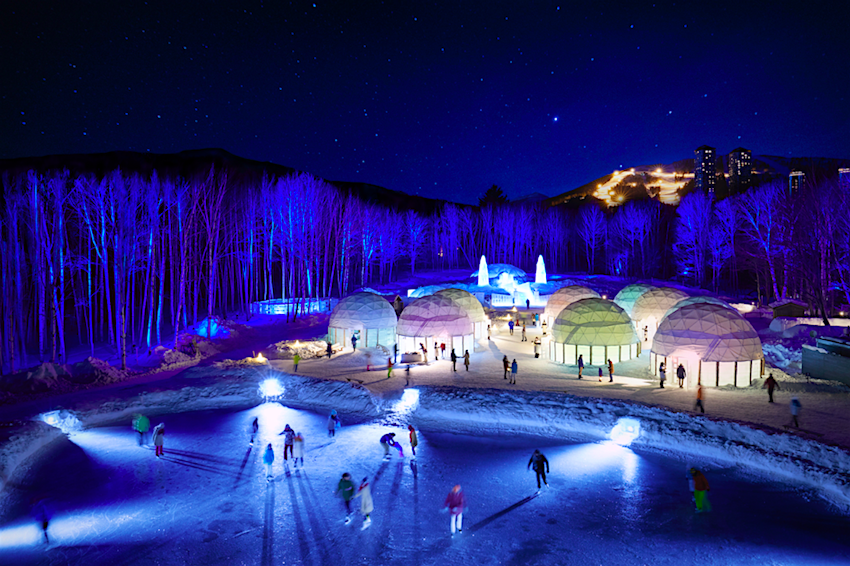
Tomamu hotel.png
This is Japan’s only ice hotel © Ice Village Tomamu

Ice Village Tomamu – Hokkaidō, Japan

Japan’s only ice hotel is a shades-down dazzler. Surrounded by uplit birch trees, the exclusive genetically-domed igloo sleeps just two people a night on its stylish ice beds, with an outdoor arctic bath and a heated dressing room to keep their lucky bones warm.

Located at Tomamu in Hokkaidō, near the smooth wide runs of Tomamu ski area, the temperatures regularly tumble to -22°F (-30°C). That may sound like visitors are consciously choosing to be cryogenically frozen, but it also means that Ice Village Tomamu guests have access to an ice rink, an ice slide, an ice instrument room, an ice chapel, an ice bar, an ice sweetshop, an ice bakery and – you’ve guessed it – an atelier that only uses ice.

Ice Village Tomamu is open December 10–March 14.

DSC_5411.JPG
There are real fires in the rooms at North America’s only ice hotel © Hotel de Glace

Hôtel de Glace – Saint-Gabriel-de-Valcartier, Canada

North America’s only ice hotel is in Saint-Gabriel-de-ValcartierCanada, and will be cutting back on the poutine this winter to present a slimmed and trimmed version of its typical regal self because of COVID-19. However, that doesn’t mean the ice chandeliers and hand-chiseled snow sculptures will come crashing down – if anything, this luxurious igloo, which comes complete with an ice chapel for weddings, becomes even more exclusive.

Hosted on the outskirts of Quebec City, master craftspeople detail the igloo’s fine frozen furniture, gleaming ice entranceways and curved snow roofs each year. With hot tubs and a sauna under the stars as well as real fires in each room, no guests should go to bed cold. There are even real mattresses and an isolating bed sheet to ensure a great night’s kip. Hôtel de Glace usually opens earlier than January 2, depending on the weather.

Hôtel de Glace is open January 2–March 21.

Snowhotel Kirkenes – Kirkenes, Norway

So far up the longitude meridian that there’s only really Svalbard in the way of Kirkenes and the North Pole, this wonderful Norwegian snow hotel is open 365 days a year. In the cold, blizzard-blanketed winters this is reindeer and husky country: a quiet, isolated region endured by only the most hardy of creatures. But for overnight guests, it’s a beautiful once-in-a-lifetime spot for a winter vacation.

Inside the plump hotel itself, artists bring each bedroom to life with snowy bas reliefs of local winter animals like wolves and owls, whilst specialist ice sculptures that line the halls and ice bar area turn frozen water into glacial artworks worthy of Frieze Art Fair.

Snowhotel is open year-round.

DANIEL FAHEYLonely Planet Writer

Being of service to ONENESS- Serving the greater good- Nishante- Nisha Designs

Years back I was leading a group of non- profit organization in San Diego. We had about 9-11 board members. We had an event that we all were preparing for and towards the end we had a little setback.

We were all discussing how to approach this situation. As one of our board member said let’s cancel the event completely. And he went a little too far enough and took the opportunity to make this event all about him and his ego. Diverting attention from the core situation which in my awareness wasn’t bad at all just needed a tweak but ok, here he goes off bringing fear to the situation, personal threats, making it all about men, women in authority, bringing doubt and question to the leadership and skill, threatening to stop the organization and what it stood for if he did not get his way, feeding information to people in the room and to people in the community that had nothing to do with what we were talking about? Ya talk about evil/ chaos in action. In short once things got quiet in the room. There was only one guy and myself on the same page. Rest were still choosing what to do.

So as a leader I chose to go ahead with the event as planned with some back up and tweaking whatever it took to keep it going. Because my focus and intent about my position and this organization and this event wasn’t about me, wasn’t about fear, wasn’t about the fame or recognition, wasn’t about what will people say, wasn’t about who is in authority, ego, power or to prove to anyone or anything, it wasn’t about me winning or loosing.

My focus was on the bigger picture serving the organization which I was responsible for as a leader. The intent I had created this event in the first place was to serve and raise money for a non profit to help in need.

I wasnt afraid at all. But one bad apple causing chaotic shit in my world of order that I could not fathom with because all his choice did was serve him not the greater good by his thoughts, action and words of intent.

So I made a statement as the leader to chose to continue with the event whether anyone was with me or not. And yes I did have that right to choose according to our organization by- laws. And they say truth, justice always prevails . Regardless of the havoc my DJ showed up, event was a hugeeee success in the history of this organizations chapter and we made enough to give the help we could.

It is our responsibility to choose leaders who are about serving the greater good and not making it all about themselves. To choose who stand for truth and not lie. Who stand for justice and not fraud and manipulation. Who are responsible in there choices, words and action.

We are here to serve. This planet is about serving in our own life and to our planet as ONE.

FLAME RETARDANT OUTDOOR AND INDOOR MERIDIAN COLORS- NISHA DESIGNS

The Colours

All fabrics in the collection are colour-coordinated and can be combined with each other.
Typical colours of the collection are sage, olive green, saffron yellow and a soft sorbet red. Bright gold, cantaloupe melon and sky blue perfectly compliment the colour mood of the Meridian collection. 
Contrasts in the colour palettes are created by the warmth of saffron yellow and burnt sienna with cool sky blue and gentle sage. The colour ranges are rounded off by elegantly patterned natural and grey shades such as desert sand and silver grey. 

For more details please visit- https://www.delius-contract.de/en/function/delimar-outdoor-1

For samples please email nisha@nishadesigns.com or call 702.622.8321

Pop-up rainforest in East Yorkshire to capture carbon, reduce flooding risk and improve soil health — Life & Soul Magazine

More than 40 farmers in the UK’s East Yorkshire region are to create a “pop up rainforest” that will help them plant a diverse range of cover crops that will capture carbon, reduce flooding risk and improve soil health. The Sustainable Landscapes Humber Project – a collaboration between Yorkshire Water, Birds Eye, Future Food Solutions and […]

Pop-up rainforest in East Yorkshire to capture carbon, reduce flooding risk and improve soil health — Life & Soul Magazine

Native Visions — Graffiti Lux Art & More — Life & Soul Magazine

Found this in a small underpass. The colours are gorgeous. Here’s the east side. It is very different from any other native street art I have found. There are a lot of faces on the west side. The faces are in organic things, like tree trunks. I have turtle love. Pics taken by Resa – […] […]

Native Visions — Graffiti Lux Art & More — Life & Soul Magazine

Women + Patterns + Plants: Helping women to reconnect to Mother Earth through colouring in

Artist and designer Sarina Mantle is helping women to reconnect to Mother Earth through a different medium – a self-care colouring book, Women + Patterns + Plants.

With a strong resonance for indigenous cultures, plant life, shamanic healing and the divine feminine, Sarina Mantle has created a beautiful book that takes the colourist on a mindful and engaging journey that is empowering.

Women + Patterns + Plants is made up of several of Sarina Mantle’s illustrations – black-and-white line drawings featuring women, patterns and plants.

The colouring book is as much a visual expression of Sarina Mantle’s journey of self-discovery. Prior to penning the book, Sarina Mantle travelled to Peru where she spent time with the indigenous women of Shipibo heritage, who are master embroiderers and painters. There she was surrounded by all the things that encompass her book – plants, textiles and women.

In an interview with Yellowzine, she said: “I felt deeply inspired by Mother Earth. I decided after my own self-discovery that I wanted to create visually through illustration; I wanted to make drawings of women reconnecting to Mother Earth. It has been my way of contributing to the collective consciousness that are returning to sustainability, nurturing plants, growing food and spending time in nature.”

Women + Patterns + Plants is a beautiful book which is a powerful way in which to nurture the connection with one’s self and one’s source, Mother Nature and her children.

Women + Patterns + Plants by Sarina Mantle is available from Amazon and independent bookstores

Rosa Medea is Life & Soul Magazine’s Chief. She writes about sustainable lifestyle and green living for publications, and offers content services to planet-friendly businesses. Find out more at Rosamedea.com

Mjøstårnet: World’s tallest timber building symbolises “green shift” to carbon-absorbing sustainable design — Life & Soul Magazine

Brumunddal in forest-rich Norway is a rural town with a major forestry and wood processing industry, which now boasts the world’s tallest timber building – the 85.4m high Mjøstårnet (The Mjøsa Tower). The 18-storey mixed-use building, which overlooks Lake Mjøsa in Brumunddal, contains apartments, the Wood Hotel, swimming pool, office space, and a restaurant. Opened […]

Mjøstårnet: World’s tallest timber building symbolises “green shift” to carbon-absorbing sustainable design — Life & Soul Magazine

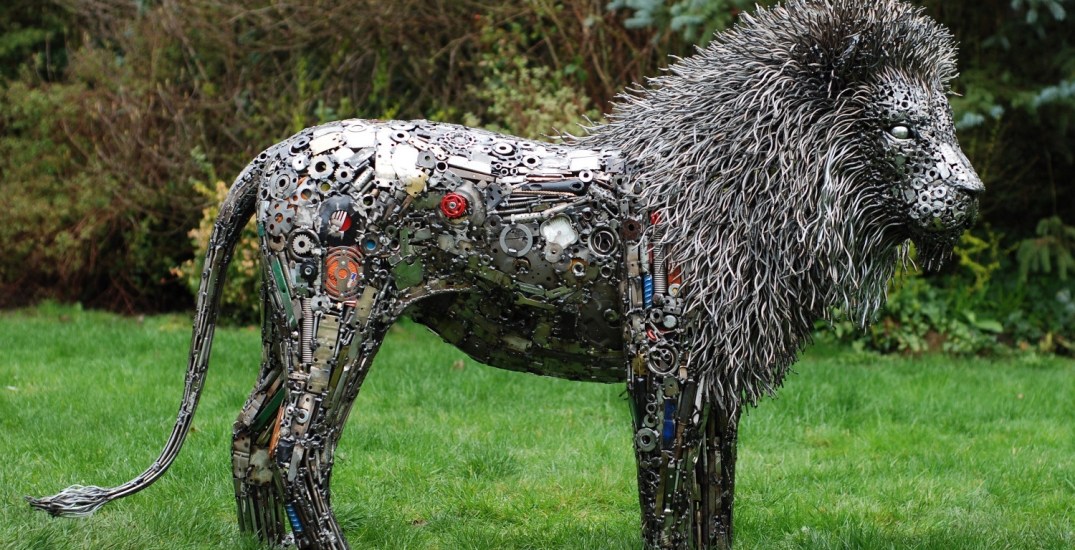
Sculptor Brian Mock creates life-size animal sculptures from recycled metals- Life and Soul Magazine

Self-proclaimed “metal evolutionist” Brian Mock is turning scrap metal into beautiful and intricate sculptures of animals, musical instruments, people, and even a deity.

The Aloha-based sculptor spent his young life drawing, and much of his adult life painting and wood carving, before his creative passions turned to sculpting with recycled metal in the 1990s. Brian Mock then taught himself how to weld, and he has since gone on to create all manner of beautiful objects from scrap metal – everything from nut, bolts, spools and more.

Brian Mock said: “Giving old, everyday objects a new life as one sculpture is an artistically demanding, yet gratifying, process. My work is designed to emphasise resourcefulness and encourage viewer engagement. Audience reactions fuel my creativity and help me bring my visions to life.”

Among the recycled metal sculptor’s artworks is California Brown Bear made using various wheel spools and other metal parts; an elephant end table; and a lion, among others.

Brian Mock added: “My sculptures are made entirely from reclaimed items and materials (almost all metal, but sometimes I’ll add bits of plastic for color). I like that people interact with them; they have fun looking for objects they can identify. It started as a hobby, but as I got better at sculpting, I turned it into a full-time profession.”

Images source: Brian Mock

Brian Mock

Rosa Medea is Life & Soul Magazine’s Chief. She writes about lifestyles including sustainable and green living. She also offers content services to businesses and individuals at Rosamedea.com

South African urban artist Sonny’s life-like paintings and murals capturing the true essence of the animal kingdom

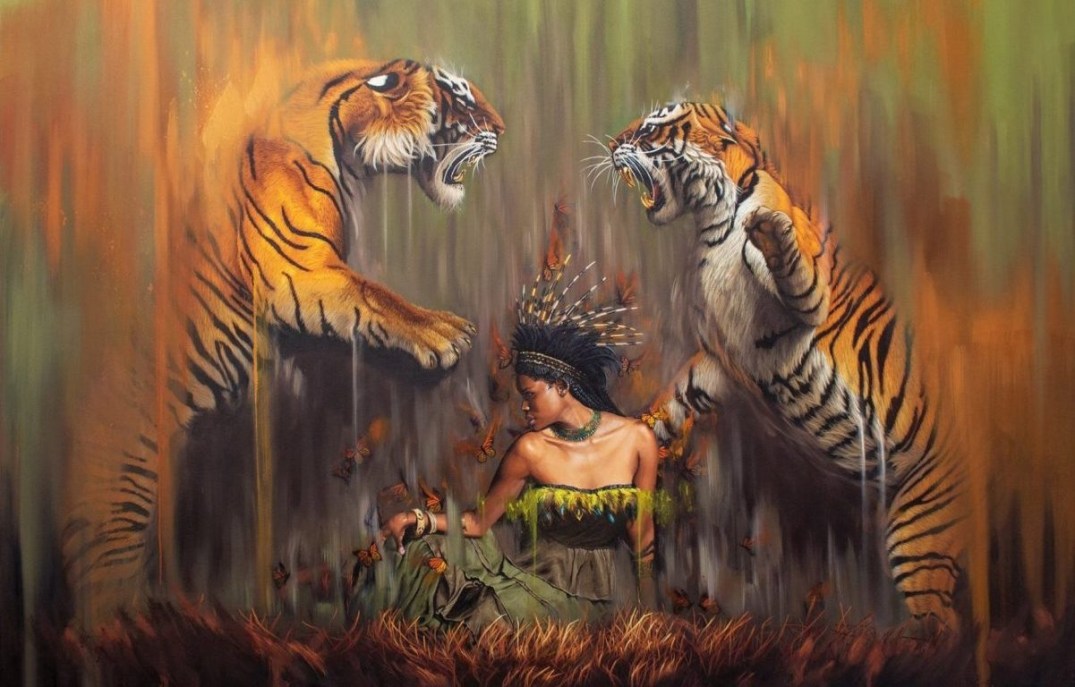
Urban artist Sonny – known for his giant murals of endangered species adorned on walls worldwide – has created a new series of animal paintings which seek to explore themes of tribal connection and ancient wisdoms.

Putting tigers, a lion and an ape within the context of their natural environment, the Johannesburg-based artist has a deep interest in ancient traditions, tribal relics and heritage where it relates to the value of the natural world.

Fascinated by wildlife from a young age, the British-born artist has since become known worldwide for his wonderful large-scale wildlife murals that are scattered across the globe.

Endangered species and conservation are just some of the environmental issues that Sonny has taken to the streets of London, New York, Ireland, Johannesburg and more to illustrate on walls as a way to imprint into people’s awareness and to encourage them to protect the animals for future generations.

From the tigers, lions, polar bears, grizzly bears, birds and rhinos emblazoned on walls, Sonny’s artworks are beautiful and fascinating, capturing the true essence of these mighty beings of the animal kingdom with every intricate detail – honouring the true beauty and power of these animals.

In 2017 Sonny launched his To The Bone project with a global mural tour that brought some of the world’s most iconic and endangered animals into urban environments around the world.

The animals depicted in To The Bone once roamed freely and in numbers across the globe, before intruders invaded their land and pillaged their forests, killing for profits and power. To The Boneconveys a deep love of and respect for the animal kingdom, as well as a sense of anxiety, guilt, and outrage towards crimes perpetrated against our wildlife.

The To The Bone project, which culminated in Sonny’s first solo exhibition in New York in 2018, was accompanied by a series of skull sculptures, made from polyurethane resin which “with their golden teeth ablaze, the skulls [of endangered species] invoke an appreciation of the might and power of these creatures, while serving as a tangible symbol for what the future may hold”.

Images Source: Sonny 

Sonny

Rosa Medea is Life & Soul Magazine’s Chief. She writes about lifestyles including sustainable and green living. She also offers content services to businesses and individuals at Rosamedea.com

Exhibition Review: Eco-Visionaries: Confronting a planet in a state of emergency, Royal Academy of Arts, London

It’s a fact: “we are facing an ecological emergency”. The likes of young environmental guardians Greta Thunberg, Xiuhtezcatl Martinez, Artemisa Xakriaba and their peers have voiced these facts for the world to take note and take action. Eco-Visionaries: Confronting a planet in a state of emergency, an exhibition that is currently on at the Royal Academy of Arts in London, on the other hand takes those facts and visualises them to encourage people to take note and to take action.

Tackling issues from climate change to food shortage, species extinction and resource depletion, Eco-Visionaries brings together artists, designers and architects from around the world who accept and acknowledge the hard facts, and are reconsidering the relationship between humans and nature.

Each visionary offers their alternative visions on how the future may look, encouraging visitors to rethink their own lives, make changes, and most importantly, to reconnect with nature. Recognising that without a connection to nature people are unlikely to take action, the exhibition invites the audience “to interact with the environment in a more respectful way, putting nature and other species’ needs before our own”.

While discussions about climate change more recently have focused on “future generations”, Eco-Visionaries serves to remind viewers that the planet is experiencing environmental changes right here, right now – as the exhibition’s introduction draws light on: “we are no longer discussing an environmental catastrophe that might impact future generations, but a catastrophe that will now drastically affect our own”.

Mother Nature waits for “no man”, so to speak, and that is what one of Eco Visionaries’s highlights, win >< win seeks to address – the mortality of humans and their demise as a dominant species. The 2017 installation win >< win, by the art collective Rimini Protokoll, which as entertaining and engaging as it is, highlights a few “home truths”: that humans are the most endangered species on this planet and so too face extinction.

Using jellyfish, one of the few species in the world to actually benefit from the effects of global warming, as a focal point, viewers sit in a small auditorium wearing headphones before the lights dim and a screen ahead unveils a mirror. The male voice poses questions to the viewers about their age and mortality, as they look at themselves through the mirror, asking them to respond with gestures such as pointing and putting up their hands. The mirror soon fades away and the audience then becomes witness to a tank of live jellyfish.

The audio, which is akin to listening to an insightful radio documentary about global warming, explains how jellyfish, who are carnivores, are rapidly multiplying due to warmer seas and a scarcity of endangered sea turtles that prey on them. Seeing such creatures up close begs viewers to ask questions about non-native species to this planet, and the volume of unwelcome critters and things that live on this planet that seek to destroy the natural ecosystems.

At some point during the 16-minute interactive installation, viewers can then see through the tank and it becomes apparent that other viewers are sitting in a similar auditorium directly opposite. On the other side of the tank, they too are experiencing win >< win, although at a different time sequence. As the audio poses further questions of the mortality of the viewers in the second auditorium, win >< win serves as reminder of the vulnerabities of the human species and that they are not top of the food chain.

The Eco-Visionaries exhibition also displays artwork from familiar names such as artist and climate activist, Olafur Eliasson. In The Ice Melting Series, Olafur Eliasson highlights shrinking polar ice caps, getting visitors to examine how the choices and actions of humans anywhere in the world impacts the rest of the world no matter how far away a land may be from them geographically.

As visitors enter the exhibition, they are invited to view a plastic globe which spins in a tank surrounded by small green particles, indicative of plastics, which is in fact having an impact on the rotations of the planet and attempting to slow it down. The installation, entitled Domestic Catastrophe Nº3: La Planėte Laboratoire, is by the Paris-based design collective HeHe.

On closer inspection of the HeHe exhibit, the particles sit on the globe like microfibre clothing creates bobbles on clothes and just sits on the garments. When you see it in the context of the globe, it appears like a dead weight. If someone has not questioned the impact of microfibres in the context of the bigger picture before, this exhibit most certainly does that.

Madrid In The Air, a film especially commissioned for the exhibition, monitors the skyline of Madrid over a 24-hour period. The film, by London-based architect and researcher Nerea Calvillo, literally brings to light the veil of pollutants in the air seen in various illuminous colours. Another film, The Breast Milk of the Volcano, sees research studio Unknown Fields present findings from an expedition to Bolivia and the Atacama Desert, source of over half the world’s reserves of lithium, questioning the sustainability of the lithium-based batteries that power most electronic devices today.

In The Substitute, artist Alexandra Daisy Ginsberg enables visitors to come face-to-face with a life-size digital reproduction of a northern white rhinoceros, the last male of the subspecies of which died in 2018. Drawing upon rare zoological archival footage as well as experimental data from AI company DeepMind, viewers are reminded of animal species that face extinction.

Eco-Visionaries excells at presenting the hard facts in a way that gets people to really think about the environment and to examine the impact of their choices on the planet. It also encourages them to make changes in their own lives and to take action.

What we are witnessing now on this planet is what happens when inaction occurs, and while taking no action is an action in-and-of itself, what Eco-Visisonaries reminds visitors is that inaction comes at a price. Eco-Visionaries also suggests that for those willing to play an active role in the survival of the planet and its healing, there is “the need to relearn how to survive without further damage to the planet and coexisting with more empathy towards other living beings”.

Eco-Visionaries relays all of these messages not in an aggressive, worthy nor righteous manner, but in a most impactful way – one that is likely to serve as a visual reminder for those who have visited the exhibition as they makes choices in their daily lives, and so making for consciously-aware, environmentally-aware choices that serve a greater good for the planet and its native species.

Image Credits: © Royal Academy of Arts, London/David Parry

Eco-Visionaries: Confronting a planet in a state of emergency is on at the Royal Academy of Arts from now until 23 February 2020

Rosa Medea is Life & Soul Magazine’s Chief. She writes about lifestyles including sustainable and green living. She also offers content services to businesses and individuals at Rosamedea.com